














Getting Started With Conversion Rate Optimisation
Download this whitepaper now and get a new one every month!
Download »by Ned Poulter on 12th December 2012
Ned Poulter looks at where the line falls between UX, CRO, SEO and many other web design disciplines whilst ultimately asking how you can leverage all of these aspects as somebody working in SEO.
The lines between UX and SEO are becoming increasingly blurred. Largely this is because many SEO techniques are now also in-line with UX best practice; they go hand-in-hand. Many of us have been aware of this mutually beneficial relationship between SEO and usability for a long time but have chosen to pay little attention to the finer details, either the client’s budget doesn’t cater for it or there are more important changes taking place and UX changes fall by the wayside.
Some top SEO companies like SEOGadget, Distilled, Seer Interactive and Koozai have naturally begun to offer UX and CRO services to complement their existing client offering, the reason for this? The skills to offer this were often already in-house and by optimising the entire process of website conversions, more so than simply getting traffic to the site, this allows us to expand upon the remit of traditional SEO and branch into user experience and CRO and ultimately, help our clients’ make more money. This post will explore the crossing of boundaries between the disciplines, and will aim to provide you with:

When you look closely at some of the algorithm updates over the last 12 months, specifically:
Taking these updates into consideration you start to realise that ultimately Google’s goal is ensuring that their index consists of the best results on the Internet, both in terms of relevancy and also user experience. If Google serves a website that offers a bad user experience causing a user to go back to the SERPs and ‘try again’, then that reflects badly on them; to Google this can be a vicious cycle and ultimately they want to avoid this!
One issue that many SEOs are commonly faced with is the inability to communicate why site optimisation recommendations should be applied in terms that the client or developer, can understand. SEOs, more often than not, need to drop the jargon and speak to them like a human, one way of doing this is to describe your recommendations in terms of improving user experience, clients can relate to this. How many times have you found yourself in a situation where even before making the recommendations a client is already looking cross-eyed and is baffled by the mentions of ‘XML sitemaps’, ‘linking root domains’ and ‘robots.txt files’?
I’ve found great successes when working with clients in approaching SEO a bit like an academic discipline, starting a site audit with a series of presentations that I dub ‘SEOSchool’. However, I’ve found that with some clients this doesn’t always resonate, they are time-pressed and more often than not simply don’t care, it’s a bit-part of their overall marketing budget and, after all, worrying about this is what they’re paying me for! So you persevere, make your recommendations, see the on-site optimisation take place, begin your day-to-day of SEO work, site traffic begins to rise and results start to materialise. Next you get a call from your client, you’ve now got their attention and they want to know what you have done to make that happen. Sound familiar? We’re back to square one…
I’ve been in this situation a few times now and personally have found that more and more that when communicating with some non technically-savvy clients SEO is best explained by focusing on how many common SEO fixes for a site are simply a process to create a better user experience. I’d urge you to do the same. Next time you’re trying to explain certain SEO changes to a client or developer, consider approaching the explanation in a slightly different way, like highlighting potential gains like for every 1 second of load time, conversion drops 7%.
Below I have identified several areas that I have found SEO and CRO techniques can be employed in tandem, including mentions of notable tools that can help you do this…
This actually lends itself to a conversation I’ve had with a number of SEOs lately regarding optimisation of page titles and META descriptions, and how ‘old school’ examples are dirtying up the SERPs:
While not the worst I’ve seen, consider the example below for a search for ‘cheap car insurance’, More Than Insurance are trying overly hard to optimise their homepage:
However this would be much better:
Many SEOs are turning to others to help write their page titles and METAs, focused on including convincing sales-orientated language with prominent call-to-actions for the user. Try this yourself; once you’ve identified your target keywords, try giving the role of writing page titles and META descriptions to your sales team, or even your PPC team.
Tip: I’d strongly recommend using SEOMofo’s Snippet Optimiser tool to test and visualise recommendations.
Writing page titles and META descriptions in the way identified above is just a start, consider the full journey your user takes through your website once they have reached it. Split testing page titles and call-to-actions allows you to test and iterate to create the optimal experience for your users. There are a multitude of tools out there to help you do this, but I’d certainly recommend looking into three that are incredibly affordable:
Don’t see how this can help? See this example from Highrise where they increased conversions by 30% simply through using Google Content Experiments (formerly Google Website Optimiser).
Worst performer in test
Conversion increase of 30%
Information architecture is a fundamental building block of user experience on your site, ask yourself:
While often overlooked, URLs are a classic example of signposting for the user. Think how many times you refer to the URL in SERPs, or glance at the URL bar in your browser to help you understand where you are on the site. Changing URLs can be an arduous but very rewarding process. Follow simple rules for this and ensure that they:
Information architecture is a vitally important aspect of your website, without a rigorous testing process some areas of your site may simply not be discovered by users. There are a number of tools to help test your information architecture, below I’ve recommended some of the best:
Listen to your customers, constantly test and iterate based on the feedback you receive. There are simply hundreds of tools out there to do this, but consider the following tools to approach this:
On-Site/Page Feedback
Session Recording
Recording your user’s journey will allow you to understand better how they are navigating the site and to identify areas of potential improvement, recommended tools:
Crowdsource User Feedback
Much like the on-site/page feedback, you can open this up in a broader way using these tools:
As marketers, our job is focused on influencing people’s opinion based on an understanding of their needs and wants. Improving user experience helps to remove instances where individuals get frustrated online, which in turn can have a negative effect on your brand as a whole.
The good news is you’re likely to already be aware of this, you just need to secure some time and resources to focus on user testing, split testing and iterating based on this feedback. Trust me, you will not be disappointed. I predict that in 2 years time the best SEO agencies out there will have flourished through offering CRO services and conducting user testing, make sure you don’t miss the boat.
To finish, I could not put it better than StateofSearch blogger Gianluca Fiorelli pointed out in his article ‘What is Google all about now’ (referencing Google’s own company philosophy):
“Focus on the user and all else will follow…”
The views expressed in this post are those of the guest author so may not represent those of the Koozai team.
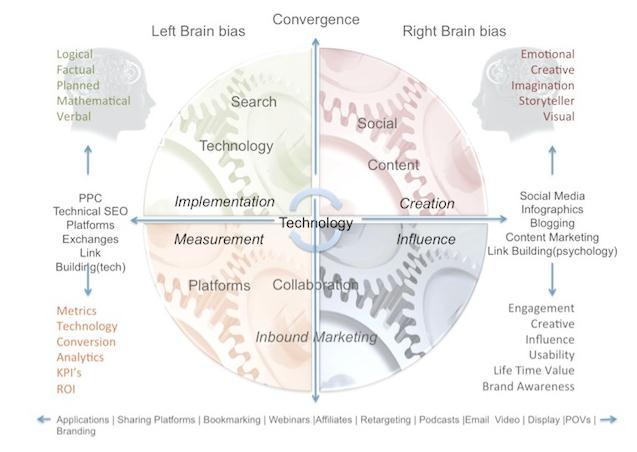
Image Credit:
User Experience Wheel and User Experience from BigStock
4 Comments
Mike Essex 12th December 2012
Hi Ned. Thanks for writing for us.
I’m really interested in where people see the lines between SEO and other disciplines and think it’s certainly a growing feeling in the industry too. One of Rand Fishkin’s recent videos put it well and he said that SEO’s need to look at what they need to do to meet the company online marketing goals and either do it themselves or lean on the right people to get the job done.
So whether it’s UX, SEO or CRO, if it helps you meet your goals you need to look at it.
Ned Poulter 12th December 2012
Hi Mike, absolutely my pleasure.
Like you, I’m also very interested in the ever-blurring lines of SEO and other disciplines, something that I love about digital marketing and how we need to constantly need to keep on our toes. I think this can be seen by simply the amount of events like The Content Marketing Show and Conversion Conference London that were attended by SEOs (myself included) this year is testament to this.
I couldn’t put it better than you in your last sentence; if it’s needed to get the job done for the client regardless of the presumed discipline then do it!
Paul Coulter 14th January 2013
Great post and thanks for sharing all those links to the tools. SEOs definitely need to take heed of your advice. Search engines want to present the best user experience to their customers, and the only way they can do that is if the websites in the SERPs also present a good user experience. SEO is certainly evolving.
Ned Poulter 17th January 2013
Thanks for your input Paul, glad that you enjoyed the post.
I certainly think that on a lot of SEOs agenda (individually and as agencies) will be merging the lines between SEO, CRO and UX; whether formally, in terms of the services they offer or otherwise. Once SEOs stop ‘chasing the algorithm’ and realising that the best results are to be had by not treating search engines as the enemy figure, they are undoubtedly going to be in a position to reap the benefits.