Website Migration SEO
Most traffic drops after a website relaunch are preventable. The ones that aren't are recoverable. Either way, you shouldn't be handling it without specialist support.
Website Migration Services That Protect Your Organic Performance
If your website is about to change; new design, new platform, new domain, or a full relaunch, your organic traffic is at risk. Not because change is bad, but because search engines and AI rely on the signals your existing site has spent years building: its URLs, its structure, its authority, its internal links. A migration changes all of that at once.
Done without specialist SEO support, that process regularly wipes out years of hard-won rankings. Traffic falls. Leads dry up. And the team responsible for the relaunch has to explain to the rest of the business why organic performance has collapsed weeks after launch, when fixing it is harder, slower, and far more expensive than preventing it would have been.
The three stages of a migration
Koozai provides website migration SEO support at three key stages
Pre-Migration
Starting any migration in the right direction is critical as this is the most important stage, this is not only the best time to map out work but also allows us to map out a plan to ensure nothing is forgotten and that no unexpected issues creep up mid or post migration. We start with working with you to understand the existing website, identify the areas driving the most organic and commercial value, and build a clear SEO migration plan. This includes crawling and benchmarking the current site, reviewing priority pages, mapping url redirects alongside any proposed changes to content and navigation. Overall, we want to preserve organic performance such as rankings, existing authority gained from backlinks alongside minimising potential negative user experience.
Migration
During the migration, our focus shifts from planning to implementation. We work closely with developers, project managements, marketing teams and any other internal stakeholders in order to ensure everybody is aware of what is being done, who owns that task and what the outcome will be. This ranges from ensuring technical foundations remain in place healthy, reviewing content to ensure that it either preserves or improves organic performance on the new site to setting up and testing conversion and event tracking across the site. Another focus during this stage is ensuring that the new site will remain crawlable and indexable by testing redirects are correctly executing, canonicals, status codes, robotxt.txt rules and XML sitemaps are all correctly implemented.
Post-Migration
After launch, we continue monitoring the website to assess how search engines are crawling, indexing and responding to the new setup. We compare rankings, traffic, conversions and priority-page performance against the benchmarks recorded before migration, while reviewing Search Console for indexing problems, crawl errors or unexpected changes. Any performance drops are investigated to determine whether they are part of normal migration fluctuation or linked to a technical or content issue. We then provide a prioritised post-migration action plan and continue supporting your team until the website has stabilised and any outstanding SEO risks have been addressed.
All of our migration work is delivered through the SAFE SEO Migration Method™ Koozai’s proprietary four-stage framework built to make migration risks visible and manageable before they become expensive problems. Our SEO migration services are built around one goal: making sure the organic search performance you’ve earned doesn’t disappear when your new site goes live. Whether you need hands-on technical support throughout the project or an expert eye on what your development team is building, we work alongside your team at every stage.
You’re probably here because one of these is true:
- Your site relaunch is approaching and you’re not confident SEO is being handled properly
- Organic traffic has dropped after a migration and you’re not sure why
- A previous migration went wrong and you’re still in recovery
- Your developer doesn’t fully understand the SEO risk of what’s being changed
- Your MD or board is asking why organic leads have slowed since the new site launched
- If any of those are familiar, you’re in the right place.
When your website changes, your search performance is at risk
What’s actually at stake
The business cost of a migration handled without proper SEO oversight is significant and consistently underestimated until it’s too late.
A Search Engine Journal study of website migrations found an average of 229 days for traffic to return to pre-migration levels following a domain move and 42% of sites never fully recovered.
229 days is seven and a half months of reduced organic leads. For a business generating meaningful revenue through organic search, that is not an SEO problem. That is a business problem and it lands on the desk of whoever was responsible for the relaunch.
The difficult truth is that most of those losses were preventable. Not with luck, but with the right process, in the right sequence, before the site went live.
Understanding the SEO impact of a website migration before you start is the difference between a smooth transition and months of traffic recovery. The pages you’ve spent years building authority on, the backlinks pointing to specific URLs, the crawl structure Google has learned, all of it is at risk if the migration isn’t handled with SEO at the centre.
Common consequences of a migration handled without SEO:
- Organic traffic drops 30–70% immediately after launch
- Google continues showing old URLs, generating 404 errors across the site
- Years of optimised page titles and metadata overwritten by CMS defaults
- Redirect errors and loops preventing Google from crawling the new site
- Staging environment accidentally indexed before go-live, creating duplicate content
- New site significantly slower than the old one, suppressing rankings further
- Link equity lost because redirects weren’t mapped correctly
Individually these look manageable. Together, they tell search engines the site they trusted no longer exists
Planning a website change and worried about losing traffic?
Koozai provides website migration SEO for UK businesses planning a site relaunch and emergency recovery services for migrations that have already caused traffic loss. We work with brands at two stages: before a migration, to protect existing search visibility during the transition, and after a migration, when organic traffic has dropped and the cause is unclear.
The problems we most commonly solve include: organic traffic disappearing immediately after a relaunch, Google continuing to index old URLs while refusing to crawl new ones, redirect errors and loops introduced at launch, staging sites accidentally indexed before go-live, and metadata overwritten by default CMS settings during platform migrations.
All of our migration work is delivered through the SAFE SEO Migration Method™, Koozai’s proprietary four-stage framework covering Scope, Audit, Fix, and Evaluate. It is the structured process we developed to make migration risks visible and manageable before they become expensive problems, and it includes a free SEO Migration Risk Checker that gives any brand planning a relaunch a percentage risk score based on their specific migration profile.
A traffic drop after a migration is not inevitable. In most cases it is the result of specific, identifiable technical failures that can be prevented before launch or diagnosed and fixed after it. The length of recovery depends on how quickly the cause is identified and how comprehensively the issues are resolved.
We have published a Website Migration SEO Rescue Guide for brands dealing with post-migration traffic loss, alongside detailed guidance on how to handle a migration correctly, the most overlooked factors during site migrations, essential metrics to monitor after a migration, and why SEO needs to be involved from the start of any migration project. Our migration case studies include work with Designlab and Penson.
Redesigns, replatforms, and domain changes regularly wipe out years of SEO work. Not because the new site is bad, but because search engines lose the signals they trusted before. Rankings fall. Traffic dips. Leads slow down.
It often happens after launch, when fixing it is harder, slower, and much more stressful to explain to the rest of the business.
Has your migration already started or going wrong?
We don’t only support migrations that are still in the planning stages, we are often brought into projects that are already underway, close to launch or have gone live and caused an unexpected drop in rankings, traffic or conversions.
When this happens, our first step is to understand what has changed and identify the issues having the biggest impact. We can review the staging or live website, redirect setup, URL changes, content transfer, internal linking, indexation and technical configuration, then provide a clear, prioritised recovery plan. We will work alongside your existing developers and internal teams to resolve the most urgent problems, protect what can still be protected and help get your migration back on track.
How Koozai approaches website migration SEO differently
Most agencies treat migration SEO as a checklist. Hand it to a junior, run through the standard steps, sign off at go-live. That approach might catch the obvious issues. It won’t catch the ones that cause 40% traffic drops three weeks after launch.
We built the SAFE SEO Migration Method™ because a checklist is not a methodology. SAFE is a four-stage proprietary framework; Scope, Audit, Fix, Evaluate, developed from handling migrations across retail, travel, healthcare, professional services, and built environment businesses.
It includes the free SEO Migration Risk Checker, a tool that gives any business planning a relaunch a percentage risk score based on their specific migration profile, so you know exactly where the vulnerabilities are before a single redirect is written.
What makes our approach different:
- Senior-led, not delegated. Your migration is handled by experienced SEO specialists. Not juniors learning on your site.
- Proprietary methodology, not a generic process. The SAFE Method is built specifically for migrations not adapted from a general SEO checklist.
- Risk-first thinking. We identify what could go wrong before it does, not after launch when the board is asking questions.
- Clear communication throughout. One point of contact. Calm updates. Straight answers you can share internally.
- We work with your team, not around them. Your developer, your project manager, your deadlines, we fit into the project.
Koozai provides website migration SEO for UK businesses planning a site relaunch and emergency recovery services for migrations that have already caused traffic loss. We work with brands at two stages: before a migration, to protect existing search visibility during the transition, and after a migration, when organic traffic has dropped and the cause is unclear.
The problems we most commonly solve include: organic traffic disappearing immediately after a relaunch, Google continuing to index old URLs while refusing to crawl new ones, redirect errors and loops introduced at launch, staging sites accidentally indexed before go-live, and metadata overwritten by default CMS settings during platform migrations.
All of our migration work is delivered through the SAFE SEO Migration Method™, Koozai’s proprietary four-stage framework covering Scope, Audit, Fix, and Evaluate. It is the structured process we developed to make migration risks visible and manageable before they become expensive problems, and it includes a free SEO Migration Risk Checker that gives any brand planning a relaunch a percentage risk score based on their specific migration profile.
A traffic drop after a migration is not inevitable. In most cases it is the result of specific, identifiable technical failures that can be prevented before launch or diagnosed and fixed after it. The length of recovery depends on how quickly the cause is identified and how comprehensively the issues are resolved.
We have published a Website Migration SEO Rescue Guide for brands dealing with post-migration traffic loss, alongside detailed guidance on how to handle a migration correctly, the most overlooked factors during site migrations, essential metrics to monitor after a migration, and why SEO needs to be involved from the start of any migration project. Our migration case studies include work with Designlab and Penson.
Redesigns, replatforms, and domain changes regularly wipe out years of SEO work. Not because the new site is bad, but because search engines lose the signals they trusted before. Rankings fall. Traffic dips. Leads slow down.
It often happens after launch, when fixing it is harder, slower, and much more stressful to explain to the rest of the business.
What’s included in our website migration SEO service
Each stage has unique goals, tasks and focuses which we’ve already briefly touched upon. If you want to know more about what to expect from each stage, here’s our breakdown of each key stage alongside the core focus and a few actions to expect from us below.
Before Launch
Focus: Protect what you’ve already earned.
- Pre-migration SEO audit and risk log
- Full crawl of the current site to baseline all URLs, rankings, and traffic
- URL-by-URL redirect mapping strategy
- Staging environment SEO review to prevent accidental indexing
- Input into templates, navigation structure, and page rules
- SEO benchmarks for traffic, rankings, and indexation
During migration
Focus: Test, analyse, rectify issues pre-emptively and identify potential opportunities.
- Redirect testing at scale before and at go-live
- Robots.txt and indexation verification
- XML sitemap validation and submission
- Analytics and tracking integrity checks
- Go-live technical checklist, signed off by a senior specialist
After Launch
Focus: Review pre and post-launch performance
- Coverage and crawl error monitoring in Search Console
- Ranking and traffic tracking against pre-migration benchmarks
- Priority page re-optimisation where needed
- Internal linking and crawl path fixes
- Clear reporting you can share with your team and stakeholders
Types of migrations we cover:
- Website redesigns
- CMS platform migrations (including Shopify, WordPress, headless)
- Domain changes and rebrands
- Ecommerce replatforming
- HTTP to HTTPS moves
- Multi-site mergers and consolidations
- URL restructures and site architecture changes
Different migrations carry different risks. We tailor the approach to what your specific migration involves, not a one-size-fits-all process.
How do we work with your developers and teams
Koozai doesn’t look to replace your teams or act as an outside team. We work alongside them and treat your website as if it was our own. We treat transparency as a key focus, ensuring that we are translating migration risks into clear technical requirements, create clear implementation details and provide support at the points where SEO input is most important. Responsibilities, deadlines and sign-off requirements are agreed at the beginning so your developers know what needs to be completed, your stakeholders know what is at risk and no critical migration task is left unowned.
Website Migration Resources
If you’re planning a website migration or recovering from one that hasn’t gone to plan, these guides will help you understand the process, avoid common mistakes and protect your organic visibility.
- SAFE SEO Migration Method™
- SEO Migration Checklist – How to Not Lose Traffic
- Website Migration and New Site Guide
- Top Pages to Protect During a Migration
- Essential Metrics to Monitor After a Website Migration
- 5 Signs Your SEO Migration Has Gone Wrong
- Website Migration Recovery
- The Likely Impact of Site Migrations in the Age of AI Search
Need expert support? Our Website Migration SEO specialists can help you plan, manage and monitor your migration to minimise risk and protect your organic performance.
Proof from real website migrations
We don’t talk about migrations in theory. Here is what protecting and recovering organic performance looks like in practice; across domain moves, platform migrations, post-migration recovery, and multi-site consolidations.
Designlab, full domain migration
Designlab, a leading mentor-led UX and UI design training provider, required specialist SEO support through a full website domain migration, one of the highest-risk migration types. Operating in a highly competitive education sector where even small visibility losses carry significant commercial consequences, there was no margin for a poorly managed transition. With Koozai managing the migration end to end; pre-migration analysis, redirect mapping, indexation monitoring, and post-launch stabilisation, the new domain was indexed quickly, rankings were maintained through the transition, and UX Bootcamp lead conversions increased by 31% in the period following implementation.
Penson, platform migration
Penson, specialist interior designers and architects, came to Koozai needing to protect organic visibility through a full platform migration while managing the challenge of consolidating a fragmented keyword landscape without losing ranking visibility in the process. Through comprehensive redirect mapping, deployment, and testing, all organic traffic and ranking visibility was retained at launch. Three months after migration, Penson had achieved 80% growth in organic sessions, a 103% increase in new users, and a 51% improvement in session duration, followed by an average of 30% month-on-month organic session growth in the months that followed.
“Carrying out a website migration can be a stressful time but Koozai were ready for the technicalities involved and our worries about the potential loss of traffic were put to rest.”
Sarah Bean, Head of Copy, Penson
Ancasta, post-migration recovery
Europe’s largest yacht brokerage network, Ancasta came to Koozai after a migration that had not been managed from an SEO perspective had introduced significant technical failures: missing and incorrect redirects, broken internal linking, metadata not transferred correctly, and search engines unable to properly crawl and index the new site. Koozai conducted a full post-migration audit, rebuilt the redirect architecture, resolved crawl and indexation issues across key commercial pages, and restored authority to the pages driving high-intent yacht buyer traffic. Organic traffic recovered within 3–6 months of the fixes being implemented, with priority pages restoring their rankings for key commercial queries and crawl errors reduced significantly across the site.
Hamble Yacht Services, multi-site merger and consolidation
When Hamble Yacht Services was acquired by and integrated into the Ancasta Group, Koozai was appointed to manage the SEO strategy for the consolidation; ensuring two previously competing sites merged without cannibalising each other’s rankings or losing the organic authority either had built. Through a full URL inventory, backlink analysis, and a detailed 301 redirect strategy with one-to-one mapping of high-value pages, the transition was completed with no loss of traffic, the top 20 keywords maintained positions 1–3 throughout, and the long-term SEO structure of the combined site was strengthened rather than compromised.
These results reflect four different migration scenarios;a domain change, a platform migration, a post-migration recovery, and a multi-site consolidation, all handled with the same senior-led, methodology-driven approach. A checklist gets you to launch day. A methodology gets you through it.
Industry contributions
Koozai has become known as an agency who solely employs experienced experts and our experts are regularly asked to contribute to industry publications including:

Types of website migration
There are five main types of site migrations, depending on the work that needs to be carried out and what you want to achieve.
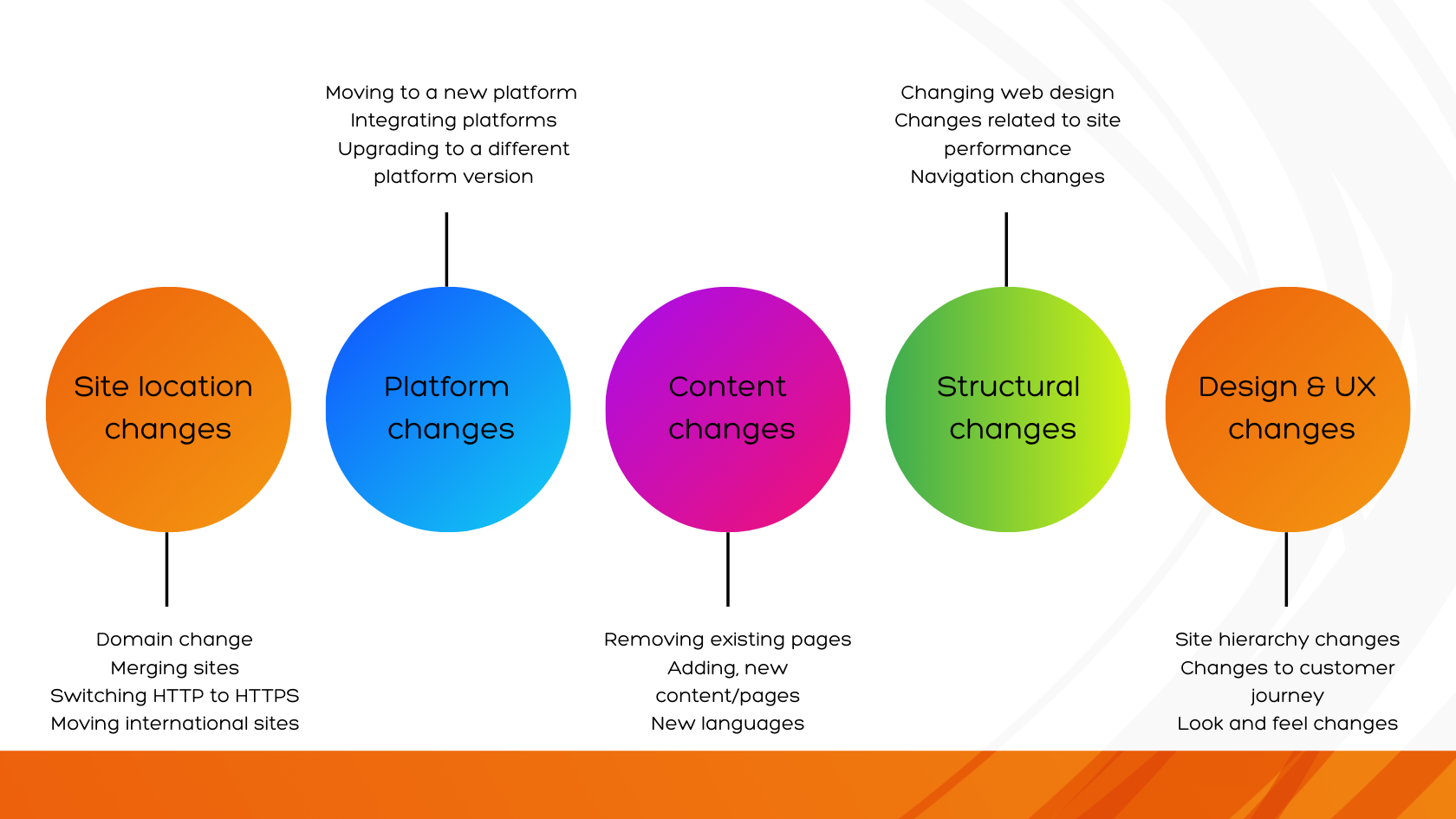
Each type of migration is unique, with individual goals and challenges that need specialist support to achieve. If you’re still not sure what you need or which one applies to you, we’ve covered each type in more detail below.
Site location changes
A site location migration involves changing where the website or its content can be found. This may include moving to a new domain, switching from HTTP to HTTPS, merging several websites, changing subdomains or restructuring international versions of a site. These migrations require careful redirect mapping, backlink checks, canonical updates and Search Console configuration to help search engines understand where the content has moved. Where international websites are involved, hreflang and regional targeting must also be reviewed to make sure the correct pages continue appearing for the right audiences.
Platform and CMS changes
A platform migration takes place when a website moves to a different content management system or ecommerce platform, integrates multiple systems or upgrades to a significantly different platform version. This could include moving to WordPress, Shopify, WooCommerce, Adobe Commerce or a bespoke CMS. A CMS migration can change URL structures, page templates, metadata, structured data, internal links and indexation controls, even when the website appears similar to users. Our role is to understand how the new platform handles these important SEO elements and work with your developers to make sure they are transferred and configured correctly.
Content changes
Content migrations involve adding, removing, rewriting, consolidating or reorganising substantial sections of a website. They can also include introducing new languages or moving content into different page templates. Removing or combining pages without reviewing their existing performance can result in valuable rankings, backlinks and internal links being lost. We assess which pages currently generate organic value, determine what should be retained or redirected and make sure priority content remains easy for users, search engines and AI platforms to find and understand.
Structural changes
Structural migrations change how the pages of a website are organised and connected. This can include updates to the site hierarchy, navigation, URL structure, category setup, internal linking or customer journey. Even where the content itself remains largely unchanged, altering the structure can affect how efficiently search engines crawl the site and how authority flows between pages. We review the proposed architecture before launch to identify pages that may become harder to reach, lose internal links or move too far away from the main navigation.
Website design and UX changes
A website redesign can affect SEO even when the domain, platform and page URLs remain unchanged. New designs often introduce different page templates, navigation elements, JavaScript functionality, mobile layouts and media files, all of which can affect crawlability, page speed and Core Web Vitals. Important content or links may also be removed, hidden or moved further down the page during the design process. By including SEO within the website redesign from the beginning, we can help improve the user experience without unintentionally weakening the elements that support existing organic performance.
Hybrid website migrations
Many migration projects do not fit neatly into one category. A business may change its domain, move to a new CMS, redesign its templates and restructure its content during the same project because it makes sense to make these major alterations if you are already making major changes to the website. These hybrid migrations, which aim to provide additional rewards, carry greater risk because several important SEO signals are changing at once. They therefore require more detailed planning, testing and post-launch monitoring to make sure issues can be identified and resolved quickly.
Already lost traffic after a migration?
If your site has already launched and organic performance has dropped, you’re not in an unusual position. And in most cases, it’s fixable, the key variable is how quickly you act.
The longer a migration problem sits undiagnosed, the more Google reinforces the wrong signals. Crawl paths bed in. Old authority dissipates. Recovery becomes slower and more expensive.
We run focused SEO migration recovery projects for sites that launched without adequate protection. We’ll tell you honestly what happened, what’s recoverable, and what realistic timelines look like.
- Our recovery work typically includes:
- Forensic audit to identify exactly what broke and why
- Redirect gap analysis and repair
- Indexation diagnosis and fixes
- Priority keyword and page recovery plan
- Honest timelines – not optimistic guesses
- Reporting you can use to update your board
- Read: Your guide to recovery after a site migration
- Read: What is an SEO migration paramedic?
- Download: Website Migration SEO Rescue Guide
Talk to a website migration SEO Specialist
If your site is changing, SEO needs a seat at the table, before decisions are made, not after launch.
Book a call with our migration team. We’ll review your plans, flag the risks that matter, and tell you honestly what level of support your migration needs.
Koozai operates as both an SEO website migration agency for businesses who need end-to-end support, and as an SEO website migration consultant for in-house teams who want senior expert oversight without handing over full control. Either way, the outcome is the same: a migration your organic performance survives.
No jargon. No pressure. Just experienced advice from specialists who have handled migrations across retail, travel, healthcare, professional services, and B2B sectors, and who have rebuilt traffic for brands where migrations already went wrong.
Further reading on website migration SEO
Our migration specialists have published detailed guidance on every stage of the migration process:
- How to handle a website migration correctly
- Why SEO needs to be involved from the start of any migration project
- SEO migration checklist: how to not lose traffic
- Top pages to protect during a migration
- Overlooked factors during site migrations
- Essential metrics to monitor after a website migration
- 5 signs your SEO migration has gone wrong
- SEO after a site redesign: don’t let rankings slip
- Your guide to recovery after a site migration
- What is an SEO migration paramedic?
- Your new website could make you invisible to AI. Here’s why
- The likely impact of site migrations in the age of AI search
- Website migration and new site guide
Case studies
Still curious? Why not read some of our client case studies.

Driving footfall for a top architects and design studio

SEO, PR, and website migration support for a leading UX education provider

Nailing SEO & PPC for the leader in hardwood flooring accessories

Carrying out a website migration can be a stressful time but Koozai were ready for the technicalities involved and our worries about the potential loss of traffic were put to rest. The team worked closely with our design agency to support the entire transition.
Koozai has helped us to realise and fine-tune not only our online presence, but they’ve helped us to stand out from the crowd for the future.
Sarah BeanHead of Copy

FAQs
Can I do an SEO website migration myself?
It is possible to use third party guides on the internet to try and implement your own migration. However, it is generally not advisable to implement a migration unless you have SEO expertise and experience in delivering successful migrations as costly mistakes are easily made. This could result in a drop in rankings and traffic for your website.
Will a website migration harm my SEO?
A quality SEO migration won’t significantly impact your website’s organic SEO traffic in the long term. However, a poorly executed migration can harm your website’s SEO significantly and result in a drop in rankings, which is why it is so important to invest in the services of an SEO specialist who is experienced in website migrations. A poor migration can result in things like broken redirects, duplicate content, and unindexed pages, all of which will hurt your website’s SEO.
How long does an SEO site migration take?
This one really depends on the size of your website, how much content it has and what you want to move over to the new website. A website with less than 100 pages is going to take substantially less time to migrate than a website made up of several hundred or even thousands of pages. Depending on the size of the website and the scope of the project, you can expect it to take anywhere from a month to a few months for a website migration to be fully completed. This is because time is needed to plan, develop a staging site, audit, implement and monitor the migration to ensure nothing goes wrong.
How much does SEO for a website migration cost?
The answer to this one is ‘it depends'. The cost of a SEO support for a website migration can differ depending on the size of the website, the scope of the project and the services required. In all cases, we'd recommend investing early in the process to ensure it's done correctly rather than opting for a “cheap” route, and having to retrospectively fix issues several times over - stalling, or even worse ruining your organic performance in the process. This always ends up costing more.
Get in touch for a quote.
Can you fix SEO problems after a website has already launched?
Yes. Recovery typically involves forensic crawling, redirect fixes, restoring missing signals, repairing internal links, and monitoring Search Console until performance stabilises.
Read: Your guide to recovery after a site migration.
How long does it take to recover traffic after a poorly handled website migration?
Recovery time varies by migration type, site size, and execution quality. A study on domain migrations reported long average recovery periods and that a large proportion did not return to pre-migration levels at all.
What is the best time of year to migrate your website?
Timing depends on your sector and how much revenue is driven by organic search.
Many ecommerce brands avoid major migrations close to peak trading periods such as Black Friday, because recovery volatility can overlap with commercial targets.
Plan your migration window around your lowest-risk period and build in time for post-launch monitoring.
What is a website migration SEO audit?
It is a review of your migration plan or live site to identify redirect gaps, indexation issues, broken internal links, lost page signals, and the highest-risk areas to fix first.
What is website migration SEO?
Website migration SEO protects rankings, organic traffic, and crawl equity when a website changes structure, platform, domain, or URL patterns.
When should an SEO specialist become involved in a website migration?
SEO should ideally be involved during the planning stage, before the website structure, templates and URLs are finalised. Early involvement helps identify risks before they become expensive or difficult to fix.
Do I need SEO migration support if my URL's are staying the same?
SEO support is always required even if your url's are staying the same. A redesign or platform change can affect content, metadata, internal links, structured data, page speed and indexation settings even when the URLs remain unchanged so it's better to be safe and have an expert minimise any potential risks.
Does every old URL need to be redirected?
Every old URL should be reviewed, but not every URL needs a redirect. Pages should redirect to the closest relevant replacement, while removed content without a suitable alternative may need to return a 404 or 410 response. The key is to understand the intent and purpose of the page and if the redirecting page will actually help the user.
Will a website migration affect Google Analytics and conversion tracking?
It can because changes to templates, forms, URLs, scripts and cookie controls can interrupt analytics or conversion tracking, so these should be tested before and immediately after launch.
Can a website migration improve SEO performance?
A migration can improve SEO performance and is often one of the main concerns when performing a migration as we want to ensure the website is setting you up for continued organic growth. We do this by reviewing site structure, internal linking, page speed and content quality to improve the overall customer journey. However, protecting existing rankings and traffic should remain the first priority due to the high risk nature of migrations.
How does an SEO help during a migration?
An SEO helps support your migration by performing a number of different tasks and creating plans which typically includes benchmarking the existing site, reviewing the staging site, mapping and testing redirects, checking technical settings, protecting priority pages and monitoring performance after launch. The exact scope depends on the type and size of the migration but an SEO helps by minimising any impacts of the migration and ensuring the site is in a state to support continued organic growth.
What are the signs that my migration has gone wrong?
Common warning signs include a sudden drop in organic traffic or rankings, old URLs appearing in Google, large numbers of 404 errors, missing pages from the index, broken redirects, lost metadata or conversion tracking no longer working. These issues should be investigated quickly before they become harder to recover from.
Is my web developer responsible for SEO during a website migration?
Your developer is responsible for building and implementing the website, but they may not be responsible for protecting its organic search performance. SEO specialists and developers should work together to manage redirects, indexation, internal links, content transfer and technical checks before and after launch.
Ready To Start?
Our awesome team are here ready to strap a rocket to your digital marketing campaigns, so what are you waiting for?

We create cutting edge, award-winning digital marketing campaigns




Questions?
Call us on 0330 353 0300, email info@koozai.com or fill out our Contact Form.