
Ahrefs started out back in 2011 as an SEO tool focused on backlink analysis. Today it is used not only for backlink intelligence but also for SEO audits, content marketing analysis and link prospecting. We have written this guide on how to use the tool to get the most out of it.
Since then, Ahrefs has become a data powerhouse, with its database containing over 532 million keywords alone, as seen on its big data page. Sheesh…
Who is Ahrefs Best for?
Due to the amount of information available and the functionality on offer, Ahrefs is best suited to people who will be using it most days:
- SEO and PR agencies/digital marketing agencies
- SEO/PR Freelancers
- In-house digital marketing teams
- Content marketing teams
For people with a casual interest in analysing domains, there are other tools more suited to a lower budget.
How Much Will Ahrefs Cost?
We cannot deny that Ahrefs is not cheap and a quick search will surface many disgruntled digital marketers complaining at the ever increasing cost of the subscription service. There is a free version; however, it is extremely limiting and lacks many of the features you will likely require from a tool such as Ahrefs.
Ahrefs allows you to customise your package to your needs by offering various add-ons and offers, there are three basic tiers:
- Lite £99 per month – The Lite plan is designed for small businesses or individuals working on a limited number of websites. It provides access to core Ahrefs data, including keyword tracking, backlink analysis and site audits, but with lower limits on projects, keywords and crawl credits. It’s a good starting point if you’re managing your own site or doing occasional SEO work.
- Standard £199 per month – The standard plan is what most freelance consultants and small to medium agencies typically use. At this level, you gain a higher project limit, keyword tracking and crawl credits alongside access to two years of historical data.
- Advanced £359 per month – If you are managing a very large portfolio, have a large team or find yourself consistently maxing out your crawl credits, the advanced tier is for you. The advanced tier offers up to five years of historical data, five thousand trackable keywords and an increased limit on the volume of extractable data. This tier is only typically needed by medium to large agencies, large internal teams and individuals measuring large volumes of data.
As mentioned, Ahrefs offers a large selection of add-ons and other tools so it’s definitely worth looking at their Plans and Pricing page to see what works best for your own needs. Here at Koozai, we pay for Ahrefs but this only makes up a part of our toolkit, as we believe it’s best to never place all of your eggs in one basket.
When Should I Use Ahrefs?
Ahrefs started as a backlink analysis tool, but over time, the team has been able to make use of the massive data set they have acquired to provide other means of analysing the data. So now you can analyse your backlinks, review keyword ranking positions, keyword research and content analysis. Much like the digital marketing industry itself, Ahrefs is constantly adapting and it is always looking to increase their tool-set on offer. This includes adding the brand radar that aims to help measure brand visibility across the AI landscape.
How Do I Actually Use Ahrefs?
To get to grips with what is on offer, a guided tour will help highlight the functionality available to you.
Metrics
Once you have successfully logged in, you will meet your dashboard. You can set up ongoing projects whereby domains you specify are monitored for changes in the Ahrefs set of metrics:

Domain Health is an Ahrefs score that takes into account conformance to SEO aspects such as accessibility, crawlability and metadata violations.
URL Rating works as a proxy for something like Moz’s Page Authority. As with these types of metrics, these tools do not represent an official score but a benchmark, so they should be used as a guide only. What is useful about URL Rating is that it provides a comparison based on 30/60/90/180-day intervals and colour codes green/red depending on how well the current domain compares.
Similar to URL Rating, Domain Rating shows the Ahrefs’ assessment of your domain. As I mentioned above, be careful not to put all your eggs in one tool’s score as this is just an estimate.
The Back Links and Referring Domains data show any gains or losses in backlinks or referring domains there have been over the previous four weeks.
Organic Keywords will show you the number of keywords your domain is ranking for. In our case, we have the amounts for the UK and US.
Rank Tracker
In the Rank Tracker tab, you can review keyword ranking performance for specific keywords you’ve chosen to target however, these require being set up to track. As you can review keyword movement when reviewing sites, we recommend only tracking a very few key terms per site as each plan has a limit on how many can be tracked. Once on the dashboard, you’ll see a summary of all keyword movements and changes in ranking groups, for instance positions 1-3 and 4-10, alongside your ‘share of voice’ which is the share of your target’s organic search traffic compared to the total organic search traffic for all tracked keywords.
Click through and Ahrefs will give you a keyword specific report. Here you can set updates to ‘weekly’ or ‘daily’.

Desktop and mobile positions, as well as the top-ranking page for the keyword, are reported on. As with most Ahrefs reports, this is exportable if you prefer to use Excel to manipulate the data.
Content Alerts
Content Alerts are covered below in the Content Explorer section. This area of the dashboard allows you to view any alerts you’ve set up for a subject and lets you set up more.
Disavow Links
Upload your pre-existing disavow file here and add to it as you navigate the Site Explorer tool and identify domains you wish to add to your disavow file. Saves on the cut and paste.
Email Notifications
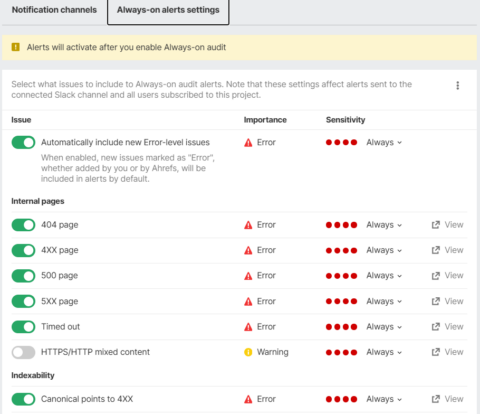
This is a very useful and simple interface that allows you to set up email notifications for the following:
- Domain Health
- New/Lost Backlinks
- Positions Tracker
You can also specify what issues (All/Critical/Non-Critical) and which backlinks (All/New/Lost) you wish to be notified of each day, week or month.
A Tour of the Ahrefs Toolkit
After you’ve familiarised yourself with the Ahrefs dashboard, you can dive into the Ahrefs toolkit.
Site Explorer
This is likely where you will interact the most. Simply copy and paste the url of the page or site you want to view into this bar and press enter!

The resulting page will feel like an assault on the senses with what seems like 100 data points, line graphs, bar charts and doughnut charts. You will find not only a dashboard but additional tools found both to the side and above the site explorer bar
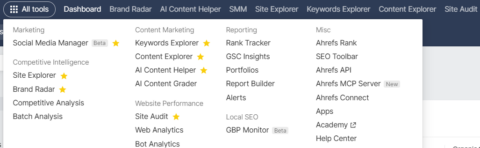
Let’s break it down a tad.
On the overview page, which you are sent to by default, you will find all of your headline metrics such as Domain Rating, URL rating, Search metrics and AI citation overview. By playing with location and time scales, you can see quick comparisons such as ranking changes over the last two years and how many citations you have received.
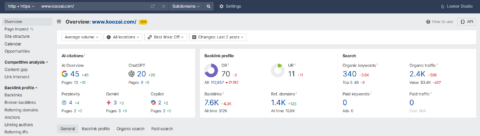
The dashboard has evolved over the years and as digital marketing grows, so does the dashboard. As you scroll down, you will see a number of condensed reporting tabs named ‘General, backlink profile, Organic Search and Paid search’ which do as they say on the tin.
Each report serves a specific purpose but let’s explore some of the graphs you can find in this area.
Graphs
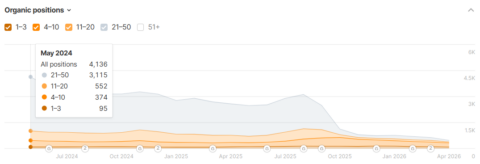
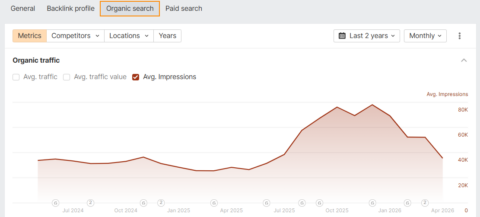
Here you will find the Ahrefs organic positions graph, which shows a general overview of the site’s keyword rankings over time. This helps give you a quick visual understanding of performance as the graph breaks down the different performance categories with colour groups.
On the same page, you can also see the ‘Organic Traffic’, which comes with a variety of filters and parameters that you can set, such as flicking between impressions, traffic and traffic value. We recommend that you always take traffic data directly from Google Search Console and Google Analytics 4 when possible, as this is only an estimation, and accuracy can vary.
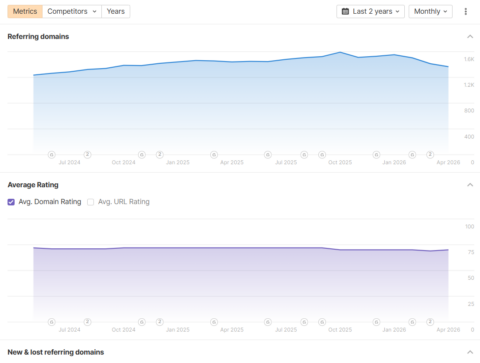
The Referring Domains data visualisation under the backlink profile tab puts that massive index to good use by plotting new and lost link quantities at the page and domain level. Using this report, you can gain a quick overview on your backlink profile by identifying not just growth or backlink losses but also see where your backlinks are coming from geographically and what your most common anchor text is.
Once you’ve familiarised yourself with the overview page reports, it’s time to dive into some of the tools on Ahrefs. We’ve gone through some of our most used and most helpful tools below that can help provide even more insight or find additional opportunities.
Link Intersect
This is a clever little bit of kit. With the Link Intersect tool, you can plug in a set of sites (up to 10) and Ahrefs will return the domains that are linking to all of the sites submitted. Just for those of you who are new to Ahrefs, the competitive analysis tool covers several areas so do not be alarmed if you see the page below after clicking on ‘link intersect’.
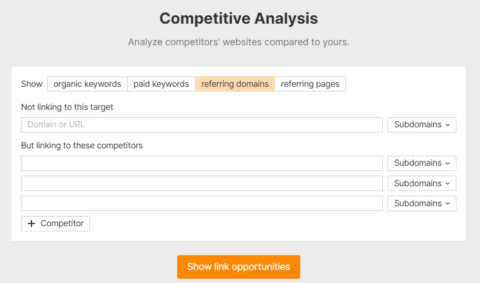
Do this for a number of your competitors to see where you should be getting some exposure. As with most reports, this is exportable.
Batch Analysis
The Quick Batch Analysis function, found under the ‘all tools’ drop-down menu, is really useful for identifying competitors and linking opportunities.
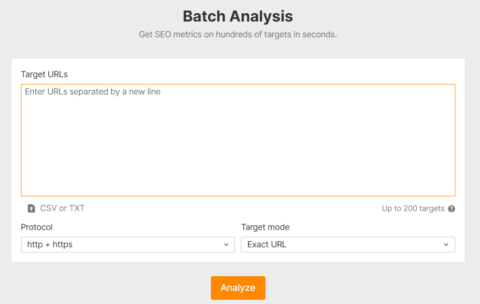
Simply drop a list of URLs into the box and Ahrefs will return the following metrics for you to analyse:
- Number of backlinks
- Number of referring domains
- Paid and Organic KPI’s
- Ahrefs URL and domain level score
Though it’s not an exhaustive list of what you will find, these are the most helpful metrics for the majority of digital marketers. You can then export this data for further analysis and get a clearer picture of not just who your main competitors are, but where you sit in your list of competitors.
Crawl Report
If you have set up a Dashboard for a site, you can gain access to a Crawl Report, which provides an analysis of your domain that lends itself neatly to SEO. To access this simply click on ‘Site audit’ in the top nav and click on the site that you have set up to be crawled.

The Crawl Report lets you review SEO elements within the Ahrefs interface. If you’re aware of dedicated crawler tools such as Sitebulb and Screaming Frog and their SEO capabilities, the Ahrefs functionality will seem limited. It does, however, give you a good overview of some of the key SEO elements to optimise and serves as another quick checkpoint when reviewing your site performance.
With the ever-useful Export function you can extract the following:
- Response codes
- Duplicate content
- Thin content (less than 50 words)
- Title tags
- Meta descriptions
- H1 tags and H2 – duplicates, missing, lengthy and multiple
- URLs – non ASCII, where underscores are used, canonical, dynamic and lengthy URLs
- Internal and external links
By using this for your site or that of a competitor, you can assess the accessibility of your site’s content, internal duplicate content levels and metadata optimisation.
There is plenty of ground that can be covered using this type of data.
Content Explorer
Ahrefs’ Content Explorer tool makes use of the massive data set of pages to help research content by topics and keywords.
Ahrefs offers 4 refinements of a query, allowing you to search for content pieces in the following ways:
- Everywhere – This means a query will search both the title and the on-page content.
- In title – If you’re testing a headline out, this function will give insight into the types of pieces using the same headline.
- In content – Use this to find content pieces using your keyword or topic only in the on-page content. This is excellent for researching headlines and also format types.
- In URL – Returns pages where your keyword appears in the URL, which can help identify how topics are structured, categorised and targeted across different websites.
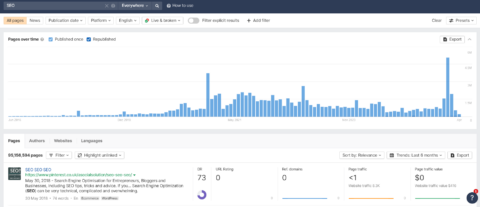
On top of this, you can filter results based on a date range, language, and you can include or exclude a specific domain. Dig deeper and use the advanced search functions to produce a highly specific search result. Industry standards like site:domain as well as specifying the exact string using “” work but you can refine your search even further.
Another neat feature to look at – especially for a seasonal topic – is the Pages over time feature. Here Ahrefs breaks down the number of documents it has found in its index related to your query by up to ten years. This can be refined through the pre-set date filters or the custom date picker.
Keywords Explorer
Ahrefs Keywords Explorer provides a view of a domain’s organic and paid keyword strengths.
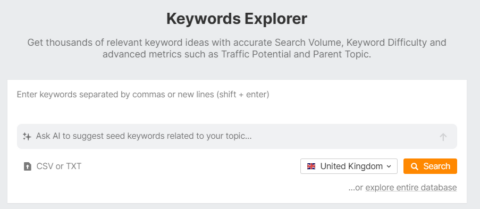
To find the keywords explorer tool, just look at the top menu bar and you will find it in-between Site Explorer and Content Explorer. This tool is where you will likely find yourself a lot of the time as you use it to perform keyword research, research topics and gather data or further insight into certain terms.
When you add a term, or list of terms, make sure to select the correct region before clicking search (This is a beginner error that catches everybody out from time to time). This ensures that you’re looking at the relevant data for the correct client or market.
Once you’ve clicked search, you will be presented with a dashboard which can be a bit overwhelming at first but lets walk through it together, to help get your bearings.
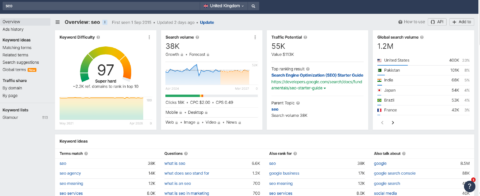
Overview: This gives you the whole picture, including:
- Keyword difficulty – An estimation of how hard it is to rank in the top 10 organic search results for a keyword on a 100-point scale
- Search Volume – An estimation of the average monthly number of searches for a keyword over the latest known 12 months of data
- Traffic potential – An average of how much traffic you can gain from being P1, but for those of you who were paying attention earlier, you will know that third party data is only a rough estimate and should only be used as guidance. Telling your client they will get this traffic is maybe something we wouldn’t necessarily recommend or sharing.
- Global Search volume – This gives you monthly search estimates across the top countries which is a great way to gain insight into not only geographical demand, but helps you compare keywords using different regional dialect. (I.E. understanding that ‘football’ has different terms for different regions such as Americans calling it Soccer)
This gives you the big picture data, allowing you to understand how much search opportunity there is, where the demand is and how difficult it will be to compete for that term. That’s great for identifying one term, but what if you’re looking for other terms and insight into user search trends? Well Ahrefs has you covered! Just scroll down and you will see Keyword ideas including:
- Terms match – A list of the top keyword ideas that show you all keywords that contain all of the terms of a target keyword in them
- Questions – A list of keyword ideas that show you search queries that are phrased as a question.
- Also rank for – These are keywords that the top ten pages that the keyword you chose rank for
- Also talk about – This highlights topics and terms that are related to your chosen keyword that you could tap into.
As part of keyword research, you will want to tap into these areas, especially when looking for matching or related terms. You can do this by clicking on the category in the left-hand menu.
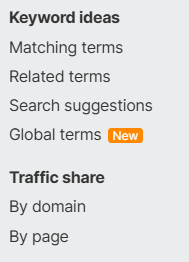
Depending on which option you clicked on, you will see either related, exact matching or loosely related terms. On this overview page, you will find not only a series of filters that let you narrow down what keywords you see, but also a breakdown of all results based on categories.
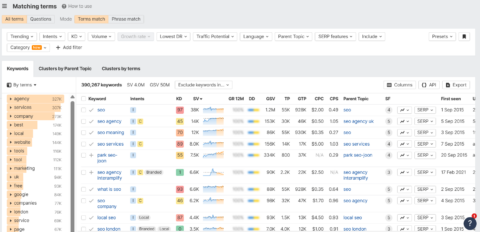
In the example above, you not only see all terms matching ‘SEO but you can also see the various topics that fall into that, such as ‘agency’ and ‘tools’, which represent two completely different types of search intent. This helps you provide keyword research that not only shows the opportunity for growth but also helps you refine that research down into relevant terms that match the same intent as your site.
With AI becoming increasingly more prevalent in the search landscape, it’s become more important than ever to ensure that your strategy aims for quality and not quantity of clicks.
Top places we use in Ahrefs
You may be wondering where the most common tools and areas we spend our time are, as everybody has different needs and requirements. As an agency, we manage a variety of clients, so using the site explorer function is where we spend most of our time. The tool itself has a lot of additional tools built into it, so here’s a few that you will benefit from exploring:
Organic Search
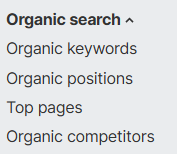
The organic search segment gives you all you need to know about your keyword performance, and allows you to analyse and break down both weaknesses and opportunities. To understand how we do that, we need to look at the various aspects of the organic search segment
- Organic keywords – This page gives you a full breakdown of your performance that isn’t available in the top level graph on the overview page. Here you can find the keywords you rank for, the average position over the time period you’ve selected and other helpful data such as average search volume, top location and ranking changes.
- Organic positions – This tab dives deeper into those rankings, detailing which pages rank for that term, the country it ranks for and what the general user intent is behind that term such as informational (those looking to learn) or commercial (those looking to buy). Here’s a little tip: if you hover over the ‘SERP’ drop-down, you can even get a brief overview of the top five SERP’s results for that term to see who your competitors are and if there are any differences in their content and purpose.
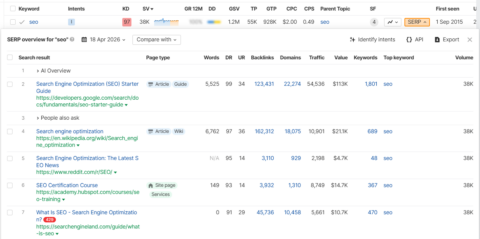
- Top Pages – This moves up to a page view, allowing you to review which pages are doing well and not so well alongside what their top terms are. This can give you so many insights but be wary of the AI content level as it’s been well documented that high-quality, human-written content is often flagged as AI writte.
- Organic Competitors – This is a great section to see who Ahrefs believes are your closest SEO competitors based on your topic and industry. We recommend that you always align with your client’s chosen competitors. For those who are part of an in-house team, you will likely know who your direct competitors are but this helps give you an idea of who you sit closely to in terms of organic performance.
Are there any cons or pain points with Ahrefs?
Ahrefs is no different to all third-party tools, in that its data is only an estimate and doesn’t contain the level of accuracy of the source, such as Google. Like us, they are also at the mercy of the Search Engine’s whims, which was seen when Google updated its scraping rules.
Google updated how its search results pages handle the num=100 parameter (which previously allowed tools to scrape 100 results per page instead of the default ~10). After the change, Google either ignored the parameter or limited its effectiveness, meaning tools could no longer pull large batches of results in a single request.
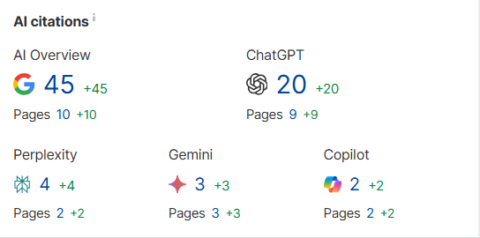
We also see the same limitations with AI, in that the channel is still extremely new and data is very limited and unreliable. Many tools have AI related reports such as ‘citations’ etc but again, take this data with a pinch of salt.
So there we have it – Ahrefs has evolved since its backlink analysis beginning by building some useful tools based on that massive index they’ve built over the years. It’s a great tool, which is why it has become an industry standard; however be cautious not to rely entirely on it as you could land in a sticky situation with a client or your boss.
There’s no doubt that Ahrefs has invested a lot of time into building a suite of tools useful to digital marketers. It doesn’t look like this is slowing down anytime soon, as they continue to add to their suite each year so make sure you always keep an eye out on what’s new and what’s upcoming.












Leave a Reply