
Koozai Puts 100 Suggestions to the Test
AI-powered search promises to make finding somewhere to eat easier than ever. But a Koozai investigation into restaurant recommendations in Portsmouth has identified closed businesses and unsuitable venues among suggestions from ChatGPT and Google AI.
AI restaurant recommendations put to the test
From finding a dog-friendly pub to choosing a restaurant for a special occasion, more consumers are turning to AI-powered tools to help narrow down their options.
Rather than scrolling through restaurant websites, menus and reviews, users can ask ChatGPT or Google’s AI-powered search features for personalised recommendations in seconds.
But how accurate are the answers?
To investigate, UK digital marketing agency Koozai tested ChatGPT and Google AI using ten identical restaurant-search prompts focused on Portsmouth, Hampshire.
The research examined 100 restaurant recommendation slots across both platforms, covering everything from affordable Sunday roasts and seafood restaurants to gluten-free dining, family-friendly venues and waterfront restaurants.
The findings identified four recommendations that failed to meet the original search requirements, including two venues recorded as permanently closed and two seafood businesses that did not meet the request for restaurants serving lobster or seafood platters.
These findings represent identified failures within the research, rather than a final overall accuracy rate for either platform.
Key findings from Koozai’s AI restaurant research
- 100 recommendation slots were examined across ChatGPT and Google AI.
- Ten identical prompts were tested on each platform, requesting five recommendations per prompt.
- ChatGPT and Google AI agreed on just 16% of equivalent restaurant ranking positions, with only eight matches across 50 comparisons.
- Two recommended restaurants were subsequently identified as permanently closed: Clarence Pier Brewers Fayre and Samphire.
- Two ChatGPT seafood recommendations did not satisfy the requested restaurant and menu criteria.
- Three identified failures appeared in ChatGPT’s 50 recommendation slots and one appeared in Google’s 50.
- The research also flagged examples of potentially mismatched sources and restaurant information requiring further verification.
The results demonstrate why AI recommendations need to be assessed against the customer’s actual requirements, not simply whether a business name appears in an answer.
AI recommended restaurants that had permanently closed
One of the clearest problems identified during the investigation involved AI recommending restaurants that were no longer trading.
ChatGPT recommended Clarence Pier Brewers Fayre
When asked to recommend five family-friendly restaurants in Portsmouth with children’s menus and high chairs, ChatGPT included Clarence Pier Brewers Fayre.
However, the restaurant had permanently closed. Koozai’s research records indicate a closure date of 30 June 2026, before the AI test took place on 20 October 2026.
A Google business listing screenshot subsequently supplied during verification also identifies the restaurant as permanently closed.
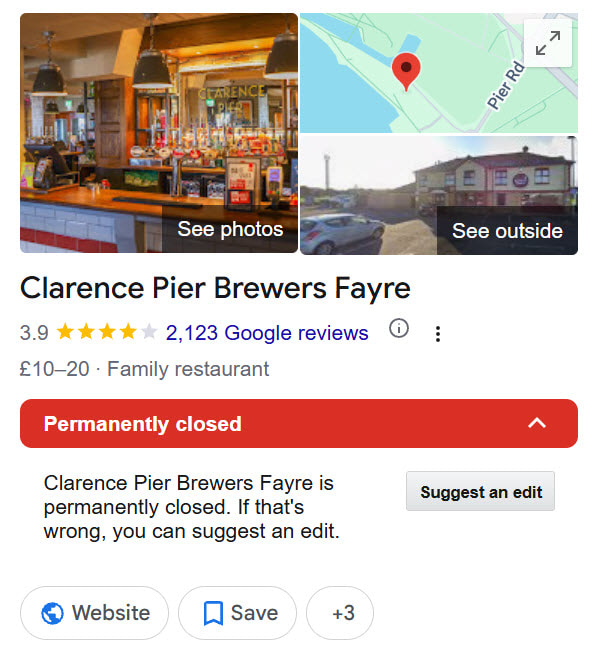 Clarence Pier Brewers Fayre was recommended by ChatGPT despite being listed as permanently closed. Source: Google business listing screenshot supplied for Koozai’s research.
This is a particularly clear example of a recommendation failing to meet a consumer’s needs. A permanently closed restaurant cannot provide a family meal, regardless of whether it previously offered children’s menus or high chairs.
Google AI recommended Samphire in Southsea
Google AI produced a similar issue when asked to recommend five Portsmouth restaurants serving fresh seafood, including lobster or seafood platters.
Among its suggestions was Samphire, a seafood restaurant in Southsea.
However, the business was identified as permanently closed in Koozai’s research. A screenshot of its Google business listing also displays a permanently closed notice.
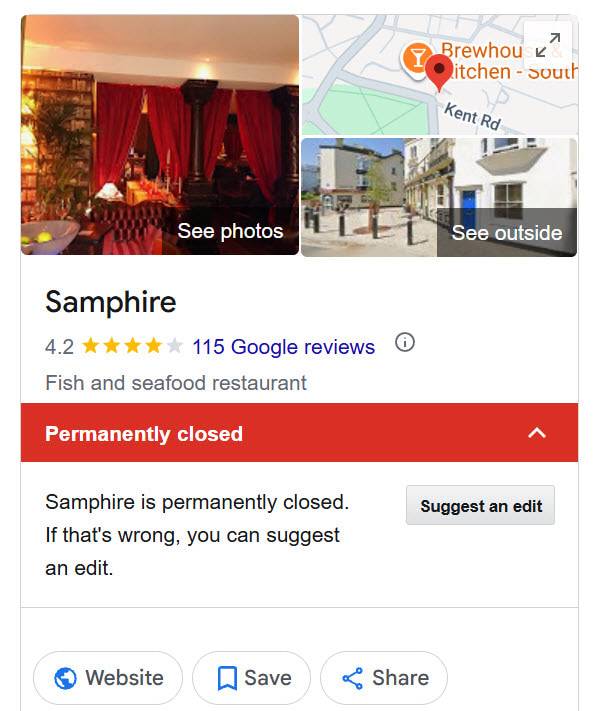
The presence of closed venues in AI-generated recommendations raises questions about how reliably AI systems identify whether local businesses are still operating.
For consumers, inaccurate trading information can lead to wasted journeys and disrupted plans. For local businesses, it also raises questions about whether AI recommendations are directing potential customers towards genuinely available alternatives.
ChatGPT also recommended seafood businesses that didn’t match the search
Outdated business information wasn’t the only problem identified.
The investigation also found examples where a recommended business existed but did not satisfy the specific requirements of the user’s search.
For the seafood scenario, the exact prompt was:
Recommend five restaurants in Portsmouth serving fresh seafood, including lobster or seafood platters.
Two ChatGPT recommendations were identified as unsuitable for this request.
The Fisherman’s Kitchen: A fish and chip shop rather than a lobster or seafood platter restaurant
ChatGPT recommended The Fisherman’s Kitchen in Southsea.
However, the business operates as a fish and chip shop rather than the type of seafood restaurant requested.
Its online ordering menu features traditional fish and chip dishes, including cod, haddock, chips and other takeaway favourites.
The research did not identify the requested lobster or seafood platters as part of its offering.
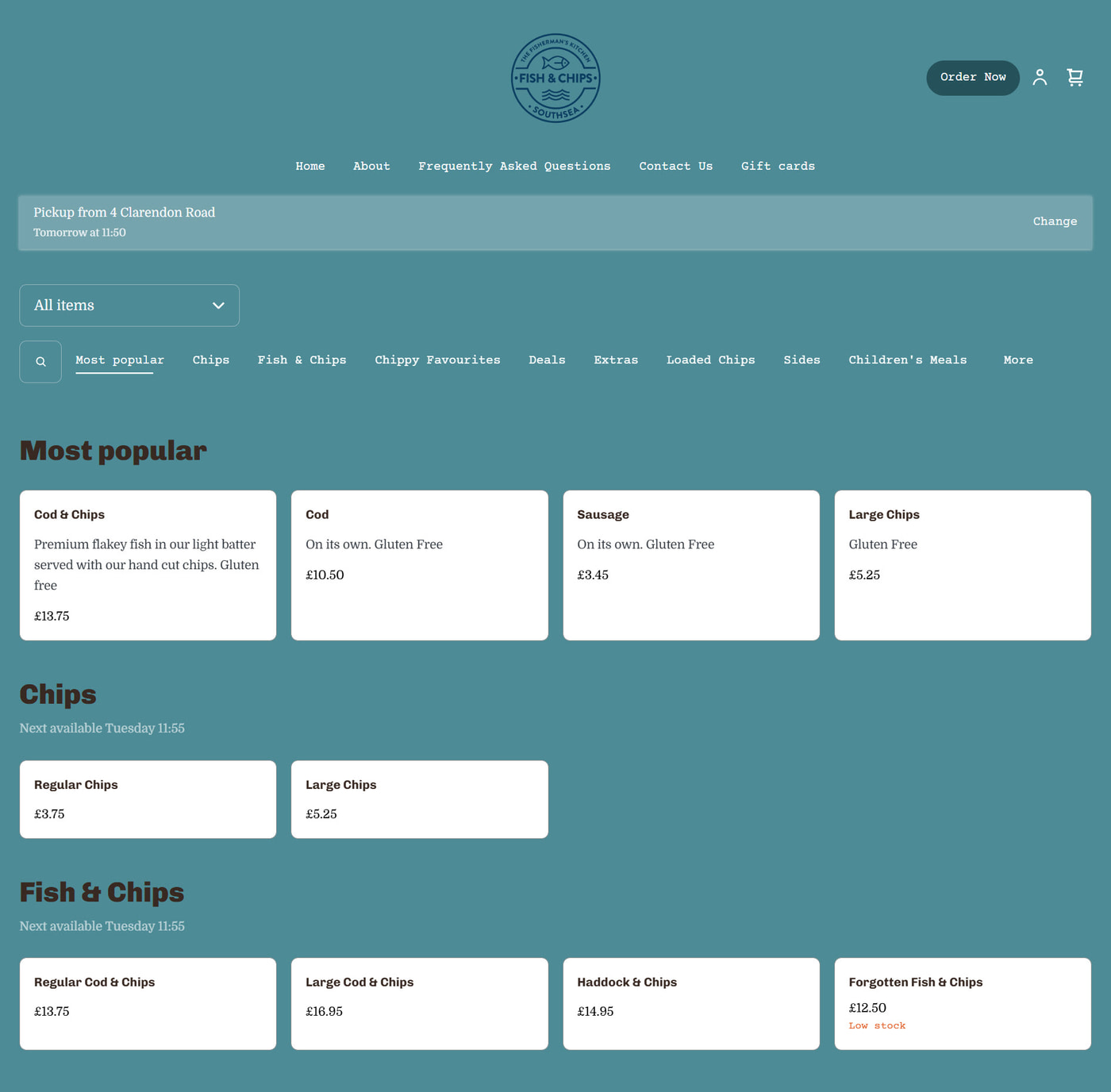 The Fisherman’s Kitchen’s online menu illustrates its fish and chip offering, rather than the lobster or seafood platters requested in the AI search. Source: The Fisherman’s Kitchen website screenshot supplied for Koozai’s research.
The issue isn’t that The Fisherman’s Kitchen is an unsuitable business in general. It is that the recommendation did not match the particular dining experience and menu requirements the customer had requested.
Hartgill Seafoods: A seafood kiosk rather than a sit-down restaurant
ChatGPT also recommended Hartgill Seafoods, located at The Hard in Portsmouth.
Hartgill Seafoods is a traditional seafood and shellfish kiosk, rather than a sit-down restaurant.
Although it is a genuine seafood business, its format does not meet the request for a restaurant where customers can dine.
This highlights a different type of AI recommendation problem: identifying a business that is related to the requested category without establishing whether it provides the experience the customer actually wants.
ChatGPT vs Google AI: What did the research find?
Same question, different dinner: ChatGPT and Google AI agree on just 16% of restaurant ranking positions
It’s not just the accuracy of AI recommendations that differs between platforms. Koozai’s research also found striking differences in which restaurants ChatGPT and Google AI chose to recommend.
Across ten identical restaurant search scenarios in Portsmouth, just eight of the 50 equivalent ranking positions featured the same restaurant on both platforms – an agreement rate of only 16%.
This means that when both platforms were asked exactly the same question, they frequently recommended different businesses or placed them in different positions.
For restaurants, this highlights an important challenge. Appearing prominently in one AI platform’s recommendations doesn’t necessarily mean a business will enjoy the same visibility elsewhere.
The findings suggest that businesses cannot assume strong visibility on one search platform translates into equally strong visibility across others.
What does this mean for businesses?
Sophie Roberts, Managing Director at Koozai, said:
“What’s particularly interesting about these findings is just how differently AI platforms can respond to exactly the same question. A restaurant could be the first recommendation on one platform and not appear at all on another.
“For businesses, this is why being visible online can no longer be about focusing on one search engine or chasing a single ranking. Customers are discovering brands in more places than ever, and each platform may present a different set of recommendations.
“At Koozai, we take a search-everywhere approach, making sure businesses have strong technical SEO foundations, clear and helpful website content, accurate business information and a credible online presence beyond their own websites.
“There’s no guaranteed formula for appearing in AI recommendations, but giving search platforms consistent, trustworthy and genuinely useful information puts businesses in a stronger position to be discovered, whichever platform their customers choose.”
Across the 100 recorded recommendation slots, Koozai identified four failures against the original search requirements.
| Platform | Restaurant | Issue |
|---|---|---|
| ChatGPT | Clarence Pier Brewers Fayre | Permanently closed |
| Google AI | Samphire | Permanently closed |
| ChatGPT | The Fisherman’s Kitchen | Did not meet the requested seafood restaurant and menu criteria |
| ChatGPT | Hartgill Seafoods | Seafood kiosk rather than a sit-down restaurant |
Three of these identified failures appeared among ChatGPT’s 50 recommendations, equivalent to 6% of its recommendation slots.
One appeared among Google AI’s 50 recommendations, equivalent to 2% of its recommendation slots.
These figures describe the minimum proportion of identified failures in the recorded dataset. They are not comprehensive error rates, because not every recommendation has been independently verified against every applicable search requirement.
They should therefore not be interpreted as evidence that Google AI is generally more accurate than ChatGPT.
Why a restaurant can exist and still be the wrong recommendation
The research highlights an important distinction between identifying a relevant business and answering a customer’s actual question.
Consider some of the scenarios tested:
- A restaurant may serve seafood without offering lobster or seafood platters.
- A pub may welcome dogs outdoors but not allow them inside during dinner.
- A restaurant may remain open until late while its kitchen stops serving food earlier.
- A venue may offer vegetarian dishes without providing a substantial choice of vegetarian main courses.
- A restaurant may advertise gluten-free options without clearly labelling them on its current menu.
- A venue may be close to the waterfront without offering outdoor tables with waterfront views.
These distinctions matter because consumers are increasingly using conversational searches to express specific needs rather than simply asking for a list of nearby businesses.
For AI-powered local discovery to be genuinely useful, recommendations need to satisfy those conditions.
Can consumers trust the sources behind AI answers?
The investigation also recorded potential weaknesses in how some recommendations were supported by sources.
For example, one ChatGPT response recommending vegetarian restaurants in Portsmouth displayed a source heading referring to Banana Tree in Henley.
Other recommendations referenced general business listings, delivery services or third-party websites when making more specific claims about restaurant menus, opening hours and facilities.
These examples do not automatically establish that the restaurant recommendations were incorrect.
However, they demonstrate why a visible source link should not be treated as proof that every claim in an AI answer has been verified.
A general restaurant listing might confirm that a venue exists without establishing whether its kitchen serves dinner after 8pm on Mondays.
Similarly, an online menu may not confirm whether a restaurant has high chairs, allows dogs inside or provides suitable arrangements for customers with specific dietary requirements.
For consumers, the challenge is distinguishing between an answer that looks authoritative and one that is supported by current, relevant evidence.
What does this mean for restaurants and other local businesses?
AI-powered search is creating another route through which potential customers can discover businesses.
Rather than relying solely on conventional search results, consumers can ask AI platforms to compare venues against increasingly detailed requirements.
That creates an opportunity for businesses whose information clearly demonstrates what they offer.
However, the Portsmouth research also illustrates how inaccurate or incomplete information can affect the usefulness of AI recommendations.
Restaurants and other local businesses should pay attention to the information available about them across their websites, business profiles, menus and relevant third-party platforms.
Useful steps include:
- Keeping opening hours and temporary closure information accurate.
- Publishing current menus and prices on official websites.
- Clearly describing facilities such as outdoor seating, high chairs and dog-friendly areas.
- Providing accurate information about dietary options and allergens.
- Making the nature of the business clear, including whether it offers sit-down dining, takeaway or both.
- Checking how the business appears in AI-generated recommendations for relevant customer searches.
These steps cannot guarantee that an AI platform will recommend a business correctly, but they help make reliable information available to search engines, AI systems and customers.
What should consumers check before relying on AI recommendations?
AI tools can be helpful for discovering restaurants and narrowing down options, but important details should still be checked before visiting.
Consumers should confirm that a restaurant is currently trading, particularly when planning a journey or special occasion.
Prices and menus should be checked against the venue’s latest official information.
For late-night dining, kitchen closing times matter more than general business opening hours.
And where dietary requirements or allergies are involved, customers should confirm the relevant information directly with the restaurant rather than relying solely on an AI-generated summary.
The more specific the requirement, the more important accurate verification becomes.
What does the research tell us about the future of AI search?
The findings highlight an important challenge as AI becomes part of everyday consumer decision-making.
Search accuracy is no longer simply about whether a system identifies a relevant website or business.
When someone asks for a restaurant serving lobster, a family-friendly venue with high chairs or somewhere to eat after 8pm, they expect recommendations that satisfy those exact conditions.
A business can be real, popular and geographically relevant while still being the wrong answer.
And a recommendation can look convincing even when the business has stopped trading.
For brands, this makes accurate online information and visibility across multiple discovery platforms increasingly important.
For consumers, it reinforces the need to check essential details before acting on AI-generated recommendations.
For AI platforms, the challenge is ensuring that answers are not just plausible, but useful, current and sufficiently supported by evidence.
Research methodology
Who conducted the research?
The research was conducted by Koozai, a UK digital marketing agency specialising in SEO, AI search, digital PR, content marketing and paid media.
When was the research conducted?
The AI searches were conducted on 20 October 2026.
Supporting checks and evidence gathering continued after the original test.
Which AI platforms were tested?
ChatGPT and Google AI were tested using the same ten restaurant-search prompts.
The research records identify the platforms by these names. Specific model versions and Google AI interface configurations were not documented in the supplied dataset.
How were the searches conducted?
Each prompt was submitted in a separate, logged-out, incognito browsing session.
This approach was intended to reduce the influence of previous conversations, account history and account-level personalisation.
However, incognito browsing does not eliminate all contextual influences, including location, platform configuration or differences in responses generated between sessions.
What was the sample size?
The research used ten search prompts, each requesting five restaurant recommendations.
This produced 50 recommendation slots from ChatGPT and 50 from Google AI, giving 100 recommendation slots in total.
These are recommendation occurrences rather than 100 necessarily unique restaurants. The same business could appear in more than one search scenario.
What were the exact prompts?
- Recommend five restaurants or pubs in Portsmouth serving a traditional Sunday roast for under £20 per person.
- Find five dog-friendly restaurants or pubs in Portsmouth where I can have dinner with my dog.
- Recommend five restaurants in Portsmouth serving fresh seafood, including lobster or seafood platters.
- Where can two people have a main course each in Portsmouth for under £35 in total? Recommend five places.
- Find five restaurants in Portsmouth offering a good selection of vegetarian main courses.
- Recommend five independent restaurants in Portsmouth suitable for a romantic anniversary dinner.
- Find five family-friendly restaurants in Portsmouth with children’s menus and high chairs.
- Recommend five restaurants in Portsmouth with clearly labelled gluten-free dishes.
- Find five restaurants in Portsmouth that serve dinner after 8pm on a Monday.
- Recommend five restaurants in Portsmouth with waterfront views and outdoor seating.
What information was recorded?
For each recommendation, the research recorded the restaurant name, platform, prompt, recommendation position, clickable business information, source links and relevant assessment fields.
Where available, the assessment considered trading status, Portsmouth location, ownership type, menu accuracy, prices, opening hours, dietary information and facilities.
Notes were also recorded where claims were uncertain, sources appeared mismatched or additional verification was required.
How were incorrect recommendations identified?
A recommendation was considered non-compliant where the research identified evidence that it failed to meet a material requirement of the original prompt.
Examples included a permanently closed venue being recommended as somewhere to eat, or a seafood business not satisfying the requested restaurant and menu criteria.
A recommendation was not automatically considered incorrect simply because its supporting information was incomplete or a source link appeared questionable.
Unverified information was kept separate from identified errors.
How were the percentages calculated?
Ranking agreement was calculated by comparing the restaurant recommended at each equivalent position (first to fifth) across the ten identical prompts. Of the 50 position-matched comparisons, eight featured the same restaurant on both platforms, giving a ranking agreement rate of 16%. Restaurants appearing in different positions were not counted as matches. This measures agreement between the two recorded outputs, not the overall accuracy or consistency of either platform.
Each platform produced 50 recommendation slots.The proportion of identified failures was calculated by dividing the number of identified non-compliant recommendations by 50 and multiplying by 100.
For ChatGPT, three identified failures divided by 50 produced 6%.
For Google AI, one identified failure divided by 50 produced 2%.
Across both platforms, four identified failures divided by 100 produced 4%.
These are observed minimum failure proportions within the research records, not final independently verified accuracy or error rates for either platform.
What are the limitations?
The study represents a snapshot of AI-generated recommendations on one test date in one UK city.
Each prompt was tested once per platform, so the research does not establish how consistently either platform would answer the same question across repeated sessions.
The sample is not representative of all AI searches, locations, restaurant categories or consumers.
Not every recommendation has been independently verified against every applicable criterion. As a result, the research cannot establish an overall accuracy ranking between the two platforms.
Closure screenshots supplied during follow-up verification show the businesses’ listed status at the time the screenshots were captured. They should be considered alongside dated closure evidence when establishing trading status on the original test date.
Menu screenshots similarly document the information visible when captured and do not necessarily prove that the same menu was available on 20 October 2026.
Findings should therefore be understood as identified issues in a defined observational test, rather than universal conclusions about the reliability of either AI platform.
Research data and media enquiries
Journalists interested in Koozai’s AI restaurant recommendation research can request further information about the methodology, exact search prompts, recommendation-level dataset and supporting evidence.
The research is intended to contribute to the wider discussion about AI search accuracy, local business discovery and how consumers assess AI-generated information.
About Koozai
Koozai is a UK digital marketing agency with expertise in search engine optimisation, AI search, digital PR, content marketing and paid media.
The agency helps businesses improve their online visibility and understand how changing search behaviours influence the way customers discover brands, products and services.







Leave a Reply