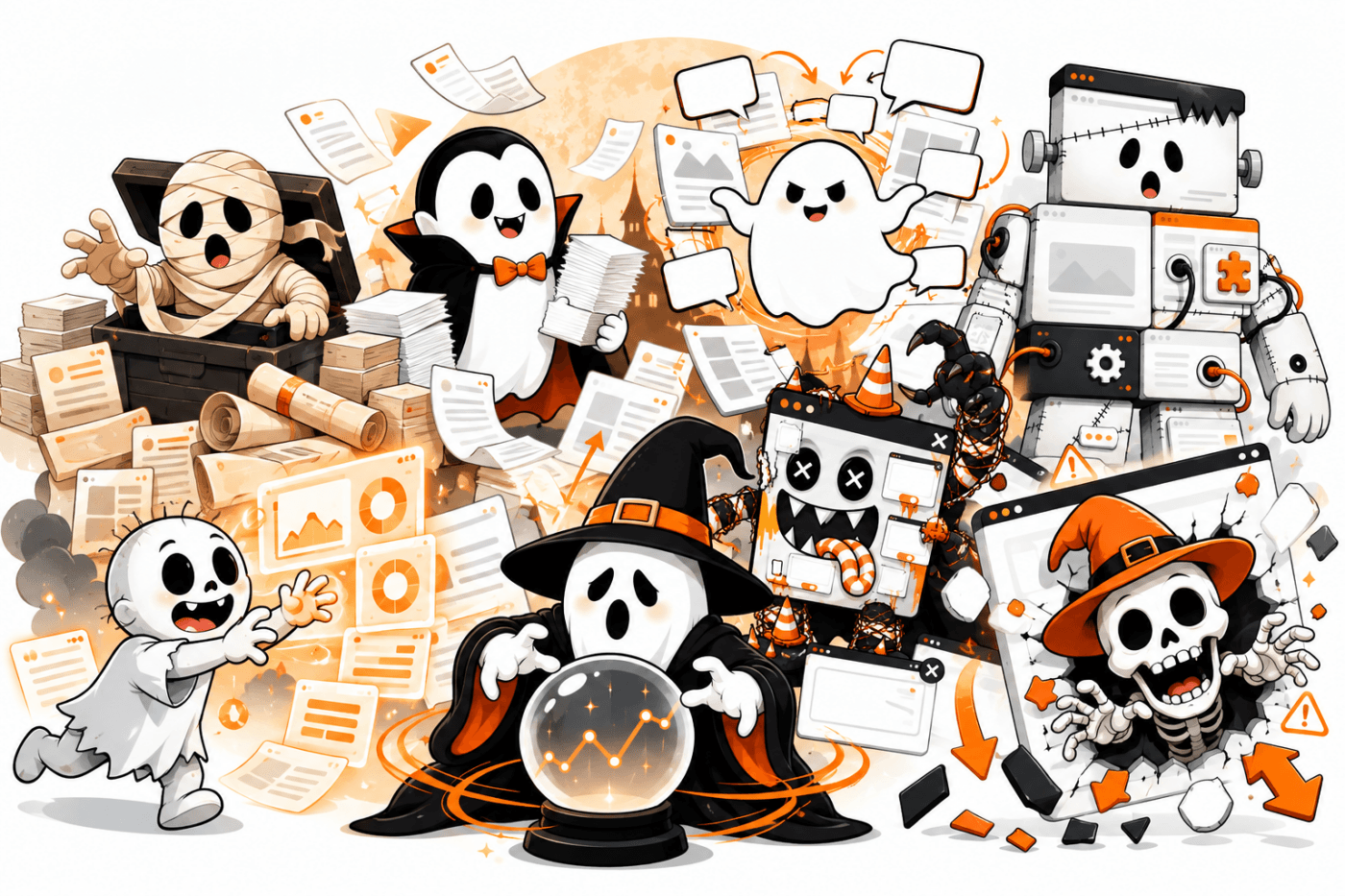
With Halloween just around the corner, we thought we’d have a little fun with some of the marketing nightmares that might sound familiar.
After all, working in digital marketing can sometimes feel like stepping into a haunted house. One minute, everything’s running smoothly. The next, an approval has mysteriously disappeared, a website has developed a mind of its own or a seemingly simple request has turned into something much bigger.
Sound familiar?
This Halloween, we’re introducing nine fictional marketing monsters inspired by the kinds of challenges people working across the industry might recognise.
From disappearing approvals and complicated websites to outdated SEO tactics and unexpected launches, there’s something lurking around every corner.
But don’t worry. We’re not just here to give you a fright.
We’ve also included some practical tips to help keep these marketing nightmares at bay.
So, without further ado, turn on the lights, grab a brew and step inside Koozai’s Marketing Hall of Horrors.
Please note: The characters and scenarios are fictional and represent broad marketing situations. They are not intended to depict any individual client, colleague or organisation.
1. The Ghost: The Disappearing Approval

“Last seen: three weeks ago. Last message: ‘Any updates?’”
Everything’s ready.
The content’s written. The designs are approved internally. The campaign is ready to launch.
There’s just one thing missing.
The final sign-off.
Days pass. Then weeks. Emails disappear into the abyss, and the approval seems to have vanished without a trace.
Then, just when you’ve almost given up hope, a message appears:
“Hi! Just checking when this is going live?”
And just like that, The Ghost is back.
Of course, delayed approvals aren’t always anyone’s fault. People are busy, priorities change and sometimes decisions take longer than expected. But when communication goes quiet, even the best-planned marketing activity can lose momentum.
How to survive The Ghost
Agree on approval processes before work begins. Make sure everyone knows who’s responsible for signing things off, when feedback is needed and what happens if deadlines change.
A clear timeline and regular communication can make all the difference.
The lesson: Even brilliant marketing needs timely decisions to keep moving.
2. Frankenstein’s Website: The Monster Nobody Dares Update

“IT’S ALIVE! Nobody knows how.”
It started as a perfectly normal website.
Then someone added a plugin.
Then another.
A new developer came along, followed by another agency, a few integrations and a collection of updates that seemed like a good idea at the time.
Fast-forward a few years, and the website has become something of a mystery.
Nobody’s entirely sure how everything fits together.
And the question everyone fears?
“Should we update WordPress?”
Silence.
Frankenstein’s Website might still be alive, but keeping it that way feels increasingly complicated.
Websites naturally develop over time, particularly as businesses grow and their needs change. The problems tend to arise when maintenance, documentation and testing don’t keep pace.
How to survive Frankenstein’s Website
Regular website maintenance is essential. Keep plugins and software updated, remove unnecessary components and make sure changes are properly tested.
It’s also worth documenting important integrations and ensuring there’s clear ownership of website maintenance.
Before major updates, make sure you’ve got reliable backups and an appropriate testing process in place.
The lesson: A well-maintained website is much less frightening than one held together by guesswork.
3. The Keyword Mummy: The SEO Tactic That Won’t Stay Buried

“Could we squeeze that keyword in one more time?”
Some things belong in the past.
Unfortunately, The Keyword Mummy hasn’t quite got the message.
This ancient marketing monster still believes the secret to SEO success is using the same keyword as many times as possible.
In the heading? Obviously.
In every paragraph? Naturally.
Three times in the same sentence? Even better.
The result is content that reads less like something written for humans and more like an attempt to summon Google’s attention.
Keywords are still an important part of SEO, but repeating them unnecessarily doesn’t make content more useful.
Search engines have become much better at understanding context, relevance and the meaning behind a search.
How to survive The Keyword Mummy
Start with what your audience actually wants to know.
Understand search intent, answer questions clearly and use relevant keywords where they fit naturally.
Well-structured, helpful content is much more valuable than awkwardly repeating the same phrase.
The lesson: Good SEO isn’t about how many times you can use a keyword. It’s about creating content that deserves to be found.
4. The Scope Vampire: The Request That Keeps Growing

“Just one tiny amendment…”
It begins innocently enough.
Could we change a heading?
Of course.
Could we add another section?
No problem.
Actually, could we update the design, add a new landing page and rethink the entire campaign?
Ah.
Meet The Scope Vampire.
This particular marketing monster has an extraordinary ability to turn a small request into something considerably larger.
And before you know it, a quick amendment has become an entirely new project.
There’s nothing wrong with ideas developing or requirements changing. In fact, being flexible is an important part of good marketing.
The challenge comes when the time, budget and resources needed to deliver those changes aren’t considered alongside them.
How to survive The Scope Vampire
Start with a clear brief that outlines the objectives, deliverables and responsibilities.
If new requirements emerge, review how they’ll affect timings, priorities and costs before agreeing on the next steps.
Good communication makes it easier to accommodate changes without putting the wider project at risk.
The lesson: Flexibility is valuable, but clear scope helps everyone know what they’re working towards.
5. The Vanity Metrics Zombie: Hungry for Impressions
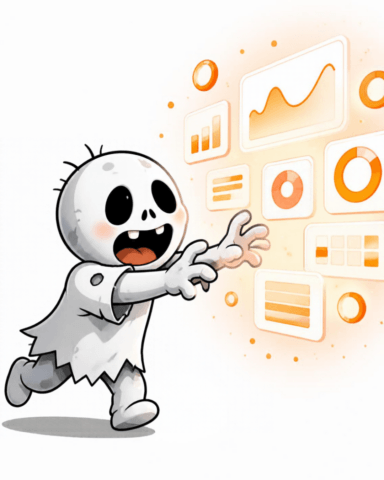
“Impressions. Impressions. IMPRESSIONS.”
The latest marketing report is ready.
Leads are improving.
Conversions are looking healthy.
The campaign is helping deliver the results it was designed to achieve.
But something has caught The Vanity Metrics Zombie’s attention.
“Why have impressions dropped by 3%?”
Suddenly, everything else is forgotten.
This monster has an endless appetite for numbers that look impressive on a dashboard, even when they don’t tell the full story.
Of course, impressions, reach and traffic all have their place in marketing reporting.
But without context, they can become distractions rather than useful measures of success.
How to survive The Vanity Metrics Zombie
Before launching a campaign, agree on what success actually looks like.
Choose KPIs that reflect the objectives, whether that’s increasing brand awareness, generating enquiries, improving conversions or driving revenue.
Then use supporting metrics to explain performance rather than treating every individual fluctuation as a problem.
The lesson: The biggest number on a report isn’t always the most important one.
6. The Website Launch Jump Scare: Surprise! We’re Live!

“Surprise! We’ve launched the new website!”
It’s an exciting day.
The new website looks brilliant.
The design is fresh, the content’s in place and everyone’s ready to celebrate.
Then someone asks a question.
“Have we checked the redirects?”
Another question follows.
“What about the metadata and existing URLs?”
And finally…
“Did anyone tell SEO we were launching?”
Cue the dramatic music.
The Website Launch Jump Scare is one marketing nightmare that’s much easier to prevent than to deal with afterwards.
A website migration involves much more than changing the appearance of a site.
Existing URLs, redirects, internal links, technical SEO settings and content all need careful consideration to help protect search visibility.
How to survive The Website Launch Jump Scare
Bring SEO into the website planning process from the beginning.
Before launch, prepare a migration checklist covering important areas such as URL mapping, redirects, metadata, internal links, indexation and technical checks.
Testing before launch and monitoring performance afterwards can help identify and resolve issues quickly.
The lesson: A successful website launch needs more than great design. SEO should be part of the plan from day one.
7. The Algorithm Witch: Google’s Latest Curse

“Google has cursed us. I just know it.”
Traffic’s dipped.
A keyword has moved down a few positions.
Something looks different in the latest performance report.
There’s only one possible explanation.
Google has placed a curse on the website.
At least, that’s what The Algorithm Witch would have you believe.
Armed with a crystal ball and a growing collection of theories, this monster is convinced every change in search performance must be the result of an algorithm update.
The reality is usually a little less supernatural.
Search rankings and traffic can fluctuate for a whole range of reasons, including competition, seasonality, technical issues, changes in search behaviour and algorithm updates.
How to survive The Algorithm Witch
Start by looking at the data.
Check when changes occurred, which pages or keywords have been affected and whether there are any wider patterns.
Look at Search Console, analytics data and relevant technical information before deciding what action is needed.
Sometimes there’s a clear issue to resolve. Other times, a small fluctuation doesn’t require an immediate response.
The lesson: Good SEO decisions come from investigation, not crystal balls.
8. The Conversion Killer: Just One More Pop-Up

“What if we added another pop-up?”
You’ve landed on a website.
Before you can read the first paragraph, you’re asked to subscribe to a newsletter.
You close the pop-up.
A special offer appears.
You close that too.
Then comes a form, a chatbot and another request for your email address.
All you wanted was to find out what time the shop closes.
Unfortunately, The Conversion Killer has other ideas.
Pop-ups, forms and calls to action can all be useful tools when they’re used appropriately.
But when visitors are constantly interrupted or faced with too many competing messages, it can make the experience frustrating.
And a frustrating user experience isn’t exactly an encouragement to convert.
How to survive The Conversion Killer
Look at your website from the visitor’s perspective.
Is it easy to find important information? Are the next steps clear? Are forms asking for more information than necessary?
Review how pop-ups and calls to action work across different devices, particularly mobile.
Use conversion data and user behaviour insights to identify areas that could be improved.
The lesson: Make it easy for people to do what they came to your website to do.
9. The Feedback Poltergeist: Back to Version One

“Can we go back to version one?”
Version one looks promising.
Just a couple of tweaks needed.
Then comes version two.
And version three.
By version four, several new ideas have emerged.
Version five introduces an entirely different direction.
And by version seven?
“Actually, looking back, I think the first version was better.”
Meet The Feedback Poltergeist.
It’s a familiar challenge in any creative process where different people bring different opinions, ideas and priorities to the table.
Feedback is essential for producing good work, but when comments arrive separately or decisions aren’t clearly owned, the process can become more complicated than it needs to be.
How to survive The Feedback Poltergeist
Agree on the objectives and expectations before work begins.
Where possible, bring feedback together into one clear set of comments rather than sending multiple rounds of conflicting instructions.
Make sure there’s an agreed decision-maker and encourage feedback that explains what needs changing and why.
The lesson: Good feedback helps creative work improve. Clear feedback helps everyone get there faster.
How to Keep Your Marketing Monsters at Bay
So there we have it. Nine marketing nightmares, ranging from vanishing approvals to mysterious ranking changes and websites that nobody quite dares touch.
While our Halloween monsters are fictional, the lessons behind them are worth remembering.
Good marketing rarely depends on one clever trick or a magic formula.
More often, success comes down to getting the fundamentals right:
- Clear communication: Make sure everyone understands responsibilities, approvals and expectations.
- Good planning: Agree on objectives, project scope and key milestones before work begins.
- Regular maintenance: Keep websites healthy, secure and technically sound.
- Meaningful measurement: Focus on results that support business goals, not just impressive-looking numbers.
- A positive user experience: Make it easy for people to find information and take action.
- Evidence-based decisions: Use data and research to understand problems before deciding how to solve them.
None of these might sound particularly spooky, but they can save a surprising amount of trouble.
And that’s something worth celebrating.
Need a Hand Keeping the Marketing Nightmares Away?
Whether you’re looking to improve your SEO, get more from your content, make your website work harder or review your wider digital marketing strategy, Koozai can help.
Our team works across SEO, Paid Search, Paid Social, Digital PR and Content Marketing to help businesses get more from their digital activity.
Get in touch with Koozai to talk through your marketing goals.
And before you go, we’d love to know…
Which Marketing Hall of Horrors character did you recognise most?
Let us know on LinkedIn or Instagram, and feel free to share your own anonymous marketing horror stories.
Just leave the real names out of it. Some things are better left buried.
Happy Halloween from the Koozai team! 🎃










Leave a Reply