
Writing blog posts is easy. Sort of. Anyone can grab a keyboard and begin typing, and a couple of hundred words later you’ll probably have an almost–legible piece of content. However, if it doesn’t have a catchy title, chances are no-one’s even going to glance at it, let alone read through it. Coming up with the perfect blog post title is an art form, developed and honed by Content Marketing experts through years of intensive training…except it’s not.
There is no mysticism or magic behind ultra-catchy content headlines; it’s just a matter of proper planning, preparation, and research. So, to help you get started, here are 7 tips for title development.
Optimise for your audience
SEO and Content go together like Mick Jagger and Keith Richards. In the sense that on their own they’re both cool but combined they really rock!
Ok, that analogy isn’t one of my best, but you should still consider optimising your titles by ensuring they’re targeted and shareable and this means researching your audience.
But exactly how do you research your audience to help craft a headline?
There are many tools out there to help, but my first three tips would be to:
- Delve into your Google Analytics to find your best-performing pages and determine where your audience’s interests lie.
- Monitor onsite search queries to get a better idea of what people are looking for on your site and use that to help formulate a relevant title.
- Use tools like Google Keyword Planner, Searchvolume.io, or SEM Rush to get a better idea of search volume and popularity.
Options
 As I stated earlier, writing a catchy headline is not an exact science. There is no magic formula or one definite answer. For this reason, it’s good to come up with a few options.
One of my personal favourite creative thinking techniques, the brain dump, is a great place to start. It can take many forms, from mind maps to group discussions, but the general goal remains the same: generate as many ideas as is possible.
This should really be done before you’ve even begun writing your content, but it’s still an invaluable technique for titles as well.
Simply look at the themes and information your research has provided and is represented within your article and note down the most relevant headings for the post. No idea is too stupid, or far-fetched. Eventually, you should have so many ideas that a general theme, or a few obvious choices, should present themselves.
Everyone has their own preferred method of idea dumping, whether it’s sketching on post-it notes, scribbling on a board, or creating documents filled with text. Just do whatever works best for you.
Once you’ve narrowed it down to a few, try them out. Read them aloud. If it’s still too difficult to be objective with your carefully crafted masterpieces, then ask for outside help. Involve your colleagues; see which they prefer. Or even use social media to garner feedback and opinion.
Pull at our heartstrings
We’re emotional creatures at heart us, humans. So, when crafting a headline, you need to have in mind that you’re essentially ‘selling’ your content to the reader. As when people make a purchase they are being driven largely by their emotions.
People will only read your content if your headline has triggered an emotional response that compels them to delve deeper.
So, when testing out headline ideas, run it through a tool like Emotional Marketing Value Headline Analyzer: This tool compares your headline to others and gives you an idea of how emotive your headlines are.
Here’s a selection of options I ran through the tool as part of my research for this piece:
- 7 Little-Known Ways to Improve Your Click-Through Rate Using A Catchy Headline – 33%
- 7 Top Tips on Writing Headlines – 38%
- Stop Your Hard Work Going to Waste – 7 Top Tips on Writing Catchy Headlines – 40%
- 7 Essential Tips to Stop Your Article Being Ignored (How to Write a Catchy Headline) – 47%
- 7 Top Tips to Stop Your Content Being Scrolled Past – 50%
- 7 Top Tips to Stop Your Article Being Ignored – 55%
The English language has about 20% EMV words, most professional copywriters aim for headlines with 30-40% EMV words. The higher the EMV score the more likely your headline is click-worthy.
Use Psychology

Yes, that’s right. There actually is some science despite what I said earlier.
As well as being emotional creatures there are also some universal truths about what the human brain likes, and you can use these to help generate more clicks.
For example, the human brain loves numbers. They make us happy; they enable us to make sense of the world and in terms of headlines it gives the reader a good idea of what to expect within the article. We like that. Below are a few tips on using numbers:
- Use numbers over words. For example, Seven Tips to Writing a Catchy Headline won’t be as appealing as 7 Tips to Writing a Catchy Headline.
- For some reason, and there’s not enough space to go into this here, but the brain trusts odd numbers, more so than even numbers. Think I’m talking nonsense? Well, a research study by HubSpot found that headlines with odd numbers in them performed better than headlines with even numbers. Go figure!
- If you’re writing a list, it’s is generally better to put the number at the start of the headline. For example, ’7 Ways to Guarantee a Catchy Headline’ is probably better than ‘How to Guarantee a Catchy Headline in 7 Steps’
Using this knowledge can help with title creation.
As well as numbers there are several special characters that can also help make a click-through more likely.
- Studies have shown that headlines containing a hyphen generate 9% more click-throughs than those without.
- And a bracket, well that’s a real game-changer. Offering up to a 38% higher click-through rate.
For example, Stop Your Content Being Ignored – 7 Tips to Writing a Catchy Headline or 7 Top Tips to Stop Your Article Being Ignored (How to Write a Catchy Headline)
Be unique and specific
Whilst it can be all too easy to get caught up in all this research you do also need to ensure that your title reflects what’s within the article. There is nothing worse, as a reader than clicking on a headline and then finding the content doesn’t provide what was promised.
Don’t confuse the audience. Just get to the point. If you’re giving 7 tips to something, then tell the reader in the headline. Be as specific as possible so they are clear on what they’re getting. This will build trust and loyalty.
Also, remember there are hundreds of thousands of pieces of content uploaded to the internet every day. And this means there are also hundreds of thousands of blog titles and headlines too.
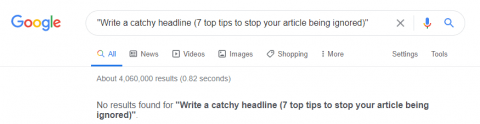
It is all too easy to craft an amazing headline, only to find that every man, woman, and the dog has used it before. You really want to make your headline unique. No-one likes duplicate content. Especially Google. The simplest way to do this is to pop your proposed title into Google with quotation marks around it – this will then show you if anyone else has used that headline or blog title before.
In the example below, you can see the headline selected has zero results. This is a good thing.
Test
This is one for the data geeks out there. If, like me, you like to see what the numbers say then set up a test. Much like in paid media, develop a split test, otherwise known as an A/B test.
Randomly split a sample audience and send your content to one group with headline A and the remainder with headline B.
The one which performs best is the one you should use.
Click Bait
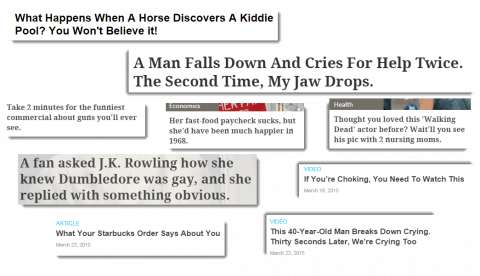
Eurgh! Okay, let’s see a show of hands, who honestly likes writing these kinds of titles, or even reading the content behind them? No one? Yeah, that’s what I thought.
Despite this, clickbait titles are incredibly effective at their job – making posts go viral.
We’ve been seeing these kinds of posts all over our Social Media feeds for years now, and that’s because sites that utilise these kinds of titles have seen enormous growth.
The formula for this is easy, simply present half the information, then question your readers’ intelligence, imagination, or emotional stability regarding what comes next:
- X did Y, and you won’t believe what happened next!
- This X has been closed for 80 years, see what happens when this lady opens it
- I cried when I saw what had happened to X, and you will too.
- Love X? Let’s see if you still love them after you see Y!
So, should you use clickbait headlines in your content?
Well, that really depends on you and your brand. If this kind of language is in line with your brand values, then it certainly wouldn’t hurt to treat yourself to some of that liquid gold and try out clickbait headlines.
If not though, you could end up pushing your audience away, and devaluing your brand; so, use with extreme caution.
The Bottom Line
At the end of the day, you can’t let a poor title impact the success of your hard work. Use some of these tips to help you create and evaluate headlines and ensure you’re getting the audience you deserve.








Leave a Reply