 Over the last two years there has been a significant increase in the number of manual penalties issued by Google. Signalled by a message in Webmaster Tools, these notices of manual spam action are much feared by webmasters who understand the potential damaging impact this action can have on search engine rankings and website traffic. But what do these messages really mean for your website and rankings?
With so many different types of manual spam action and corresponding Webmaster Tools messages, how do you know what impact the action is actually having on your site? In this post I’ve looked at the different types of manual action, how these can be identified and most importantly what they mean for your website and business.
Site-Wide Or Partial Match?
There are two main types of action; partial match or site-wide match.
Partial match action is applied to specific pages, sections or links (either inbound or outbound). This type of manual penalty is both less impactful and generally easier to recover from.
Site-wide match action is applied for more serious guideline breaches which cannot be pinpointed to a small number of pages, sections or links. Site-wide action is generally more difficult to recover from and can sometimes mean the entire site is removed from the search engine index. This would mean not just drops in rankings but the complete removal of your site from Google, meaning your website would not even rank for your brand name.
The method for recovering from a manual action is very much dependent on the reason for which it has been applied. The cause of the action is signalled by a message in Google Webmaster Tools which is different for each type of issue.
The Most Common Reason For A Manual Penalty – Unnatural Links
While there are a number of other causes of manual action, far and away the most common is those taken against sites with unnatural links.
There are currently three types of manual actions relating to unnatural links:
Unnatural links to your site – impacts links
The “impacts links” message is issued when Google realises that “some links may be outside of your control”, meaning that they do not hold you fully responsible for the unnatural links.
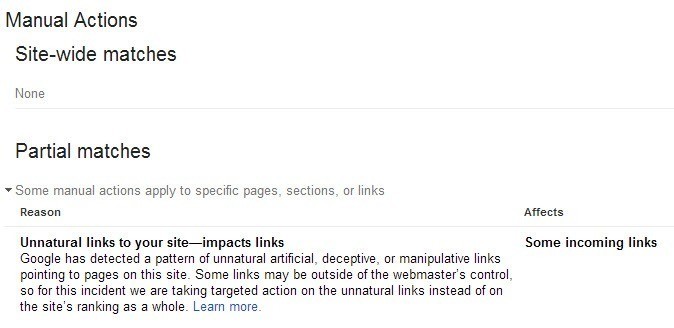
This is arguably the best type of manual penalty to receive as the impact it has on your site is likely to be minimal in comparison. This is because “targeted action” has been taken against the inbound links, devaluing them without directly or manually affecting your rankings or indexing in Google.
However, there can be indirect effects to your rankings if the links that have been discredited were previously providing value and strengthening the search engine’s trust in your site. If the link or links were previously having a strong positive influence on your current search engine performance and have been devalued by Google, without other strong links you may find your site slips down the search engine results page.
Recovery action: You need to carry out backlink analysis to find links that could be considered unnatural. You can then get these links removed or nofollowed if they provide referral value for your site. You can also disavow any links you think could be causing the problem using the Google Disavow tool. Submit a reconsideration request and await a response. While you wait, consider new ways to generate strong, natural links by creating quality content that people will naturally want to link to and share.
Google’s help on the “Unnatural links to your site—impacts links” manual action
Unnatural links to your site
This message, when not followed by “impacts links”, is more significant and potentially problematic, as the manual action has been taken against your site rather than just the inbound links themselves.
It is likely you will notice some of your keyword rankings drop, or some pages disappear from the search engine index altogether. If you have a large site and aren’t able to easily pinpoint the damage, you may notice a drop in organic traffic by reviewing your Google Analytics and comparing the number of visitors you would normally receive, looking for any sharp drops.
Recovery action: Carry out a comprehensive backlink analysis and get unnatural links removed. Disavow any spammy or low quality links you cannot get removed and submit your first reconsideration request through Webmaster Tools, explaining the work you have carried out to rectify the issue. You may have to repeat this process numerous times, leaving a few weeks in between each reconsideration requests to increase the chance of manual review. With enough work it is perfectly possible to overturn this penalty and have the manual action lifted, but it could take time.
Google’s help on the “Unnatural links to your site” manual action
Unnatural links from your site
This penalty is issued when Google finds outbound links on your site which breach their guidelines. These include links that were paid for without being properly and clearly marked as “sponsored”, irrelevant links, pages set up purely for lists of links and reciprocal linking schemes.
While this manual action can have a significant impact on your site’s search engine performance, the good news is that your site’s fate is in your own hands as you have control of your outbound links. Unlike unnatural inbound links, with this penalty you should be able to resolve the issue internally without relying on external websites cleaning up links for you.
Recovery action: Look for any outbound links on your site which are in breach of webmaster guidelines. Remove any such links and pages from your site before submitting a reconsideration request.
Google’s help on the “Unnatural links from your site” manual action
Other reasons for manual actions
Although penalties for unnatural links are the most common type of manual action, there are in fact a number of other actions Google occasionally takes, each also signalled with its own message in Webmaster Tools.
Currently there are seven types of manual action, in addition to the three unnatural link penalties:
Hacked site
This message indicates that some or all of your website pages may have been hacked by a third party. This kind of malicious activity means that your visitors aren’t seeing the pages or content they would expect. Google does not want to index these sorts of pages and applies a manual penalty as a result, highlighting the issue to you and allowing you to resolve it before requesting reconsideration.
Recovery action: If your site has been compromised, you will need to contact your hosting provider and regain full control of your site. You will then need to review and assess the damage and may need your site cleaned and protected by a professional. Check out this Google resource for site owners of hacked sites for more information on dealing with hacking.
Google’s help on the “Hacked site” manual action
Thin content with little or no added value
Google expects webpages to contain a reasonable amount of unique and quality content on every page of your site. Having pages which don’t have a good amount of content suggests that the pages cannot provide value to users and are not likely to rank highly.
Recovery action: If you receive a penalty for thin content, review your website pages and look for any which don’t contain at least 250-300 words of text. Make sure you don’t have any pages with chunks of the same content as either another page on your site or pages on external sites. Get rid of pages which don’t have enough content to provide any value and develop existing content to provide a better user experience. You can then submit a reconsideration request to Google.
Google’s help on the “Thin content with little or no added value” manual action
Pure spam
This message indicates that some of your pages or even your entire site uses spammy techniques which are in breach of Google’s guidelines. This can include automatically generated content, copying content from other websites, serving different content to users than to search engine crawlers, or any number of “other repeated or egregious violations of Google’s quality guidelines”.
Recovery action: Review your site to make sure you are not using any techniques designed purely for search engines. Google wants to rank websites which are delivering the best user experience, not ones that are able to stuff low quality content on pages for search engines. Make sure that everything on your site is useful for users and submit a reconsideration request.
Google’s help on the “Pure spam” manual action
User-generated spam
User-generated content, or UGC, is when your website users contribute some form of content to your site. Used correctly, UGC can be used as an effective Content Marketing technique. However, UGC is sometimes hijacked as a spammy link building technique. UGC spam is most commonly found in forums, user profiles and comments on posts.
Google wants to eliminate all forms of spam on the websites it ranks, so if it spots your site is riddled with fake comments or other UGC spam used for building links, it will punish the hosting site as it believes all websites should take responsibility for the content they host and that webmasters should have measures in place to prevent and eliminate user-generated spam.
Recovery action: Look for spammy blog post or forum comments and ensure that any outbound links are nofollowed, meaning they don’t flow PageRank from your site to the next. Remove spammy user-generated content that includes irrelevant links, particularly if the clickable text is keyword optimised. For example, if someone named “buy car insurance” comments on one of your posts about ladies shoes, linking their comment to a car insurance site, there’s a good chance it’s spam!
Google’s help on the “User-generated spam” manual action
Cloaking and/or sneaky redirects
Cloaking is when sites show different pages or content to users than to search engines in an attempt to manipulate search engine rankings. “Sneaky redirects” refers to landing page redirects which send users to a different page after a short delay which the search engines don’t see.
Recovery action: Make sure none of your pages use this sort of manipulative tactic. Once caught blatantly breaking the rules like this, it can be difficult to recover and get back into Google’s good books. Expect to put in a lot of work cleaning up your site and making sure it delivers value to users if you want to rank well again for relevant terms.
Google’s help on the “Cloaking and/or sneaky redirects” manual action
Hidden text and/or keyword stuffing
Using hidden text in the code of a webpage that is not shown to users is another old-school on-page optimisation technique which breaches Google’s webmaster guidelines. Similarly, trying to build relevance for certain keywords by overusing them in your content provides little value to your users and looks spammy to search engines.
Recovery action: Remove any text which isn’t clearly visible on your pages, including text that is the same font colour as the page background. Read through the text on your pages and make sure it reads well for a user and makes sense. If it’s overstuffed with keywords then you should consider rewriting the content altogether to make sure any use of keywords is natural and unforced.
Google’s help on the “Hidden text and/or keyword stuffing” manual action
Spammy freehosts
Lastly, if you allow others to host content and profiles on your site such as user profiles, micro sites or shared hosting, it is important that you ensure that everyone follows proper guidelines. If “a significant fraction of the pages on sites hosted on a service are spammy”, Google will take action against the whole service.
Recovery action: If you run or use a free web hosting service, it is important that you know it is spam free. Check out this Google resource for more information on running and using free web hosting services.
Google’s help on the “Spammy freehosts” manual action
The First Step To Recovery Is Knowing You Have A Problem…
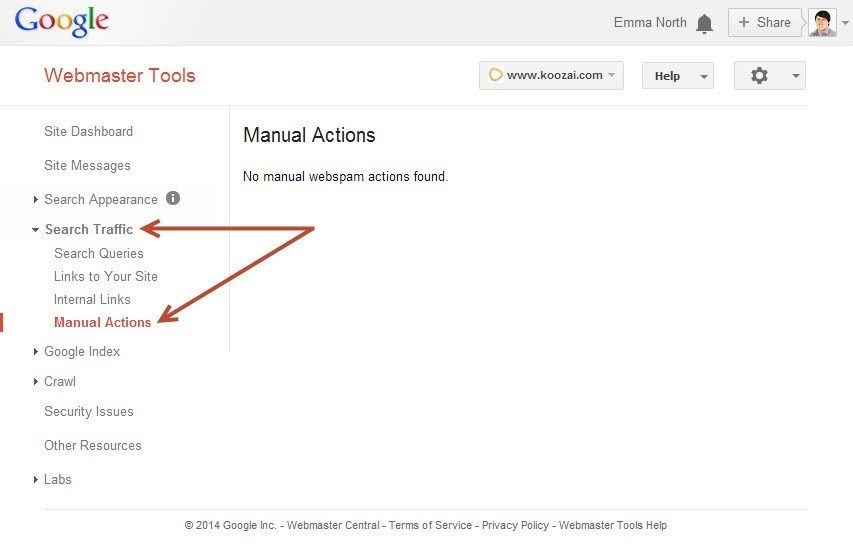
It is important to check Google Webmaster Tools regularly to ensure that your site is accessible by the search engine giant. It is here that you will receive any manual spam penalties.
You can check the status of any manual actions, and indeed check if you have any, in the Search Traffic section of Webmaster Tools:
I hope you have found this guide to Google’s manual action and spam notices useful. For more information on Manual Actions, please see this Google help page, leave a comment below or get in touch with us today.
Image Credits
Penalty Image Credit Via Bigstock











Leave a Reply