
With The Devil Wears Prada 2 set to land in cinemas on 1 May 2026, anticipation is building around the return of one of Meryl Streep’s most iconic roles. Nearly two decades after the original film’s release, Miranda Priestly remains one of cinema’s most recognisable characters, and the sequel is expected to generate significant global interest.
However, while nostalgia and cultural relevance suggest a strong launch, new data reveals a more nuanced picture of how Meryl Streep’s films perform worldwide.
By analysing Ahrefs search volume data across more than 100 countries, Google Trends interest over the past five years, and box office performance, we created a Global Popularity Index (out of 100) to identify which of Streep’s films truly resonate with audiences today.
The results highlight a clear global leader, strong regional divides, and important insights into what this could mean for the upcoming sequel.
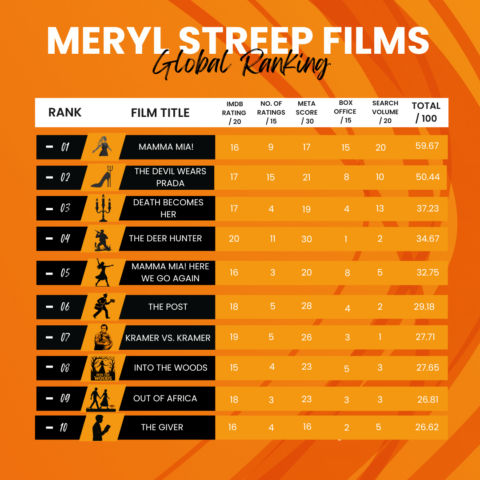
A clear winner: Mamma Mia! leads the global rankings
According to our combined index, Mamma Mia! ranks as the most popular Meryl Streep film overall, achieving one of the highest scores across all three metrics: commercial success, global search demand, and sustained cultural interest.
The film performs particularly strongly in Ahrefs data, generating consistently high monthly search volumes across major markets such as:
- United States (134,000 searches)
- United Kingdom (49,000)
- Brazil (36,000)
- Germany (18,000)
- Australia (14,000)
In addition, it ranks as the most searched Meryl Streep film in approximately 70% of countries analysed, making it the most geographically dominant title in her catalogue.
This combination of broad international reach, high rewatchability, and multi-generational appeal has helped Mamma Mia! maintain long-term demand well beyond its initial release.
The Devil Wears Prada ranks highly, but tells a different story
While Mamma Mia! leads overall, The Devil Wears Prada performs strongly across the index, particularly when it comes to cultural relevance and sustained search interest.
The film ranks as the most searched title in around 1 in 5 countries, with especially strong performance across:
- Turkey (4,300 searches)
- Indonesia (2,300)
- Saudi Arabia (2,100)
- Egypt (1,800)
- Japan (600)
These markets suggest that the film resonates most in regions where themes of ambition, fashion and workplace dynamics hold strong appeal.
Unlike Mamma Mia!, which achieves near-universal popularity, The Devil Wears Prada demonstrates a more regionally concentrated but deeply engaged audience base.
This distinction is important. While it may not dominate globally, the intensity of interest in key regions suggests that the sequel could perform particularly well in markets where the original film has already established strong cultural relevance.
Regional divides shape global film popularity
One of the clearest insights from the data is the extent to which regional preferences influence film popularity.
Europe: a stronghold for Mamma Mia!
Across Europe, Mamma Mia! is overwhelmingly the most searched film, topping the rankings in countries including:
- United Kingdom
- Germany
- Spain
- Italy
- Sweden
- Netherlands
This consistency suggests that European audiences favour light, escapist content with strong nostalgic appeal, particularly when combined with widely recognised music.
Asia and the Middle East: The Devil Wears Prada leads
In contrast, The Devil Wears Prada performs significantly better across:
- Asia
- The Middle East
- North Africa
This reflects a preference for aspirational storytelling, with the film’s themes of career ambition, fashion and status resonating strongly in these regions.
Localised outliers reveal cultural nuance
Beyond the two dominant films, the data also highlights several regional outliers:
- Out of Africa leads in Kenya and Namibia, likely influenced by its setting
- The Laundromat performs strongly in India and Pakistan
- The Giver ranks highly in parts of East Asia
- Mary Poppins Returns appears in smaller European markets
These variations reinforce the importance of cultural context in shaping audience interest.
What the index reveals about true film popularity
By combining three different data sources into a single index, a more complete picture of film popularity emerges.
- Box office data reflects historical commercial success
- Ahrefs search volume captures current audience demand
- Google Trends highlights cultural relevance over time
This approach reveals that success is not defined by a single metric.
Some films perform strongly at the box office but generate limited ongoing search demand. Others, like The Devil Wears Prada, continue to attract attention years after release, driven by cultural relevance and repeat engagement.
What this means for The Devil Wears Prada 2
The data suggests that The Devil Wears Prada 2 is likely to benefit from strong existing interest, particularly in regions where the original film continues to perform well.
However, it also highlights a key challenge.
Unlike Mamma Mia!, which achieves widespread global dominance, The Devil Wears Prada relies more heavily on regional strength and cultural resonance.
This could mean that:
- The sequel performs exceptionally well in key markets
- Global performance is less uniform
- Long-term success depends on whether it can expand beyond its existing audience base
In short, while the sequel is well positioned for a strong release, replicating the global reach of Streep’s most dominant films may prove more difficult.
Methodology
We analysed Ahrefs search volume data across more than 100 countries to identify the most searched Meryl Streep film in each market. We included over 50 films that Streep has featured in, based on this IMDb ranking. We also incorporated Google Trends data from the past five years, alongside box office figures, to create a Global Popularity Index scored out of 100.
This combined approach provides a more balanced view of both historical success and current audience demand. Data was collected March 2026 and is subject to change.









Leave a Reply