
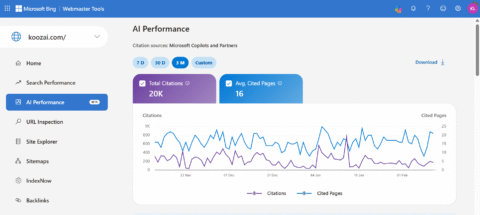
Microsoft has introduced AI Performance reporting in Bing Webmaster Tools, now in public preview. This is the first time publishers can see how often their content is cited in AI-generated answers, including Copilot, AI summaries, and selected partner integrations. This is not about clicks or rankings. It’s about visibility as a trusted source in AI outputs.
For marketers and SEO teams, this gives a new metric to measure influence in a space that is increasingly shaping user behaviour.
What the Dashboard Shows
The AI Performance dashboard focuses on four key metrics:
- Total Citations – This metric shows how often your content is referenced in AI answers. Unlike traditional impressions, it reflects how frequently AI relies on your content when generating responses.
- Average Cited Pages – This shows the number of unique pages cited daily. A narrow set of pages indicates that only a few pieces of content are being relied on, while a wider spread shows broader recognition.
- Grounding Queries – These are the phrases AI uses to locate and reference your content. Grounding queries provide insight into the intent and topics AI associates with your site, which can guide content planning and optimisation.
- Page-Level Citation Activity – This breaks down citation counts by individual URLs. It highlights which pages are most frequently used as sources and which may need attention to improve their referenceability.
Why AI Citations Matter
Traditional SEO metrics such as clicks, impressions, and rankings no longer tell the full story. AI Performance reporting shows which pages are being trusted and used by AI systems. This is important for organisations looking to maintain visibility in places where users may get answers without ever clicking through to a website.
Even though this data does not include traffic or engagement metrics, it provides early insight into content authority in AI outputs. Understanding which content AI trusts can inform priorities, resource allocation, and optimisation strategies.
Practical Steps for Using the Data
- Validate high-value pages – Identify pages that are frequently cited and ensure their content is accurate, up to date, and structured clearly. These pages are already viewed as reference-worthy by AI systems.
- Improve under-cited content – If important pages are rarely cited, review their headings, structure, clarity, and coverage. Adding concise summaries, FAQs, and supporting references can make them more accessible to AI.
- Leverage grounding queries – Grounding queries reveal how AI interprets your content. If the queries differ from your intended topics, it may indicate gaps in coverage or clarity, providing direction for content adjustments.
- Track citation trends over time – Regularly monitor how citations change. This helps you understand the impact of content updates, new pages, or structural changes on AI reference patterns.
What This Means for Content Strategy
AI citations represent a new form of visibility. While it does not replace traditional SEO metrics, it complements them by showing which content is actively influencing AI-generated answers. Companies that integrate this data into their SEO and content planning will have a clearer picture of content authority and relevance in AI-driven discovery.
For now, the dashboard is in public preview and some limitations remain. Grounding queries are generalised, and engagement metrics are absent. However, early use can provide a strategic advantage by highlighting which content is already influencing AI and where there are opportunities to improve.
Google Needs to Do It
Bing is leading the way by providing first-party AI citation data, giving publishers concrete insight into how their content is used in AI-generated answers. Currently, Google does not offer this level of visibility. Search Console includes AI-related overviews, but these are aggregated and do not show page-level citations or grounding queries, so you cannot see which content is actually being referenced by AI.
For SEOs and content teams, this is a clear gap. Google needs to provide comparable reporting so that teams can understand and optimise for AI visibility across its platforms. Until then, Bing gives a rare window into AI influence, and monitoring these metrics can provide a strategic advantage.
Conclusion
The introduction of AI Performance reporting is a significant step for publishers and marketers. It gives a first view of AI citation visibility, providing insight into which content is trusted, how it is used, and where improvements can be made.
For teams focused on measurable outcomes, this is not just a nice-to-have. It is an additional tool to guide content strategy and optimise for visibility in environments where users increasingly interact with AI-generated answers.









Leave a Reply